
While its foremost competitor in the theme park space often touts that its existence can be ascribed to a fictional mouse, Universal can attribute its contemporary standing as a traditional and themed entertainment behemoth to a slightly less endearing, but equally as enduring product of the imagination: the monster.
It’s not hyperbolic to assert that Universal, as the multi-pronged global conglomerate we know today, would not exist sans its Monsters franchise, an initially disparate, but ultimately interconnected series of films released between 1931 and 1956 that would allow the studio to wade the treacherous financial waters brought on by the Great Depression while simultaneously laying the foundation for a cinematic genre that would evolve into a Hollywood pillar. The company didn’t invent the age-old abstraction of ‘monsters,’ nor did it create many of the creatures its now quintessential films center around; it also didn’t unilaterally conceputalize horror-based cinema, but what it did was weave these elements at a time in which audiences yearned for notional, supernatural terrors to distract them from the horrors of reality, providing a proverbial escape for moviegoers while establishing for itself an escape from potential demise.
The American film industry was not unique amongst domestic institutions in that it was greatly disrupted by the Great Depression, with nearly 35% of the country’s theaters shuttering by 1932. Considered one of Tinseltown’s “Little Three” studios throughout much of Hollywood’s early 20th-century ascent to prominence, Universal did not control its own cinemas and was, thus, not as directly impacted by theater closures as its larger competitors that also had stakes in the exhibition business; that said, fewer screens on which to present their pictures presented an obvious obstacle for what was a then secondary studio. It found a path forward in the form of 1931’s Dracula, a film adaptation of a Bela Lugosi-led stage play that was itself a rendition of Bram Stoker’s 1897 novel; an overt horror film that borrowed aesthetic and tonal cues from the German Expressionist movement, the vampire picture proved quickly profitable for Universal, prompting the company to fast-track an adaptation of a stage play based on Mary Shelley’s seminal Frankenstein: or, The Modern Prometheus novel. Released just 11 months after Dracula, Frankenstein was rooted in the same inspirations as its monstrous predecessor, it, too, resonating with audiences as the two movies ushered in Universal’s only profitable year of the Great Depression.
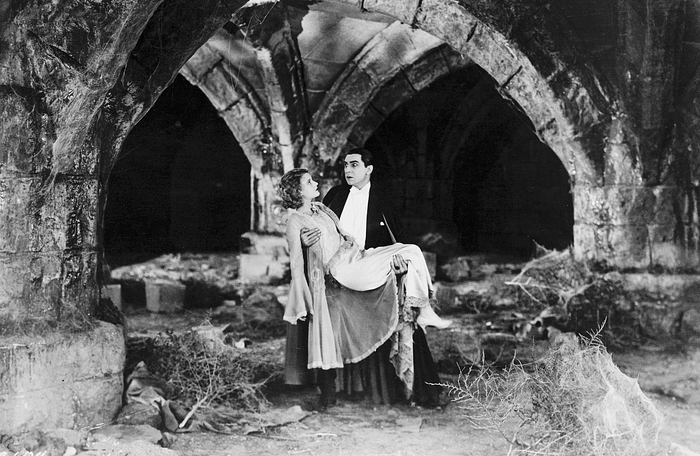
The company became “the premier studio for horror pictures” following its 1931 releases, often leaning on the genre as a trusted source of profit throughout the succeeding decades; Universal’s now epochal Monster films were among the horror movies produced by the company throughout this period, with The Mummy, The Invisible Man, The Bride of Frankenstein, The Wolf Man, and The Creature from the Black Lagoon (and sequels to several of these films) being released between 1932 and the mid-1950s. These films aided not only in Universal’s, at one point, uncertain survival, but in its ascent to global prominence, with these movies, in many cases, introducing general cinematic audiences to what would become culturally iconic characters while offering what would prove to be their definitive portrayals. Even if you, personally, haven’t seen Dracula or Frankenstein, you’ve seen people dressed as their respective monsters for Halloween. You’ve seen countless references to the Bride of Frankenstein’s electric hairstyle across media. You’re at least familiar with the designs of the Wolf Man or the Creature from the Black Lagoon, as their images have become ingrained in pop culture over the greater part of the last century.
I write this brief history to illustrate just how foundational the Monsters property is to Universal as an entity, with no other franchise being as intrinsically entwined with the company despite its later contributions to the zeitgeist. And given just how elemental the IP is to Universal as a studio, it’s not at all surprising that the Monsters have long had representation at the company’s theme parks, this manifesting over the decades in the form of walkaround characters, stage shows, themed restaurants, tangential E-tickets (both built and unbuilt), and a near permanent presence at the annual Halloween Horror Nights event.
A quick-service eatery and bizarre musical pale in comparison, however, to a dedicated theme park land, a theoretical oasis for admirers of Universal’s structural IP that, for so long, has felt like a pipe dream despite the franchise’s importance to the company. That fantasy will soon be realized as Dark Universe opens as part of Universal Epic Universe, the company’s third traditional Orlando gate that will commence general operations on May 22; an intricately detailed, endlessly immersive land that layers the coalescence of the company’s legendary monsters amidst a slew of original lore, Universal describes Dark Universe as a “grim world of myth and mystery,” a tangible story that it hopes will “make the next generation fall in love with the Monsters.”
If it wasn’t clear through the lyrical I’ve waxed on throughout the opening paragraphs of this piece, I unequivocally adore the Universal Monsters films of old; I’ve spent a potentially embarrassing amount of time analyzing the movies and writing theses about their impact (don’t worry, they were for college), and I find them eternally fascinating as not only individual productions, but as relics of a bygone cinematic era and, more broadly, as cultural touchstones. A themed land celebrating the franchise and embracing its atmospheric ingenuity has long been something of a personal white whale, a hypothetical I’ve envisioned for over a decade; Dark Universe, in many ways, is my single-most anticipated themed entertainment area of all time, as my excitement greatly precedes its confirmed existence.
I recently had the opportunity to visit the land as part of an Epic Universe Annual Passholder Preview, and while I made a concerted effort to shed my bias (of which there was admittedly some), I will concede that I was perhaps predisposed to enjoying the area given my aforementioned adoration of the Monsters IP. A counterargument, however, could be that my eye would be inherently too critical given my marked anticipation and excitement — the old ‘setting your expectations impossibly high’ quandary we humans often create for ourselves.
And Dark Universe, to my genuine surprise, did not meet my lofty expectations.
It exceeded them.
I’ll stand on ceremony a bit longer here with some necessary caveats: I, to my dismay, only spent one day at Epic Universe, and I was, thus, unable to experience everything Dark Universe has to offer; that said, the bulk of my time in the park was spent within the proverbial walls of Darkmoor, so I was able to gather a rather comprehensive understanding of the area. I’ll also warn that this review contains slight spoilers for the land, so if you want to enter your first outing completely blind, I suggest bookmarking this review for a later time.
With all preamble behind us, I’m ecstatic to report that Dark Universe is the themed entertainment haven that Universal Monster — and general horror — enthusiasts have long yearned for, a delicately crafted sanctuary of spooky that’s as effective a celebration of the company’s pillar franchise as it is an approachable, infinitely immersive themed setting. It’s a singular, thoroughly impressive achievement in its current state, and it has the bones of an area that, with continued growth and investment, could evolve into one of — if not the — best theme park land in North America.
It possesses, in bulk, the components that the median consumer values in a themed entertainment area — captivating theming, innovative and entrhalling attractions, diverse dining options, etc. — but what sets Dark Universe apart from its contemporaries both at Epic Universe and in the broader theme park space is its storytelling aptitude, its ability to convey a cohesive, throughline narrative that gives the land a level of verisimilitude matched only by the world’s elite themed settings. Guests walking into the area aren’t setting foot in just another corporate construction joined loosely by a similar aesthetic — they’re entering a story, a narrative in which every element is working in tandem to progress a single idea.
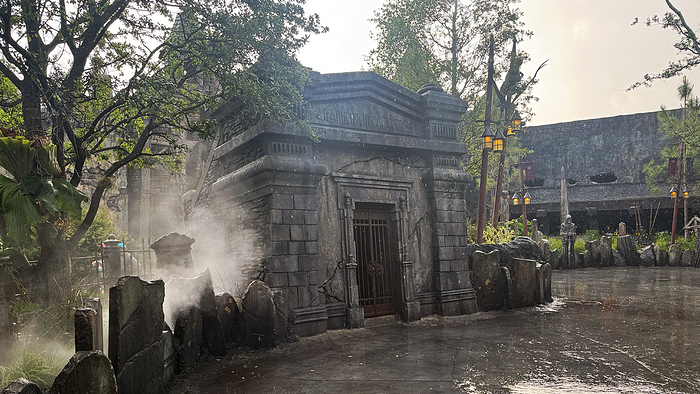
And the land wastes not an inch of space to tell its story, with everything — from the entry portal to the flagship E-ticket attraction to the literal pavement — existing to progress the narrative in some form. Dark Universe transports guests to the foreboding stone-paved streets of Darkmoor, where the potentially malevolent Dr. Victoria Frankenstein has gathered under her control Universal’s iconic library of monsters in an effort to restore her family name; this conceit is the central premise of not only Monsters Unchained: The Frankenstein Experiment (the land’s marquee attraction), but of the entire setting, with all of the land’s ancillary elements existing to supplement and further the story of the land’s primary E-ticket.
Guests relaxing in Darkmoor’s town square may come across roaming violin players who occasionally share stories about Victoria or the village’s past. A trip to The Burning Blade Tavern may result in an encounter with a monster hunter, who will have their own opinions about the land’s central character and the monstrous creatures who inhabit the town. Those who choose to meet The Bride of Frankenstein, the Monster, or the Invisible Man may strike up a conversation about Victoria and her treatment of the monsters, with some of these characters even having questions about the legitimacy of her lineage.
It’s the complementary and entwined nature of all of these elements — and the resulting ability to uncover additional layers of the story by engaging it with it more critically — that make Darkmoor feel breathing, malleable, and lived-in; the fact that you can enhance your understanding of the narrative you’re experiencing by watching streetmosphere or by literally striking up a conversation at the town bar adds a level of realism and authenticity that I’ve felt in very few other themed areas. It, in several ways, feels like a more effective execution of what Disney aimed to accomplish with Star Wars: Galaxy’s Edge; I’m as big of a Batuu fan as they come, but I feel Darkmoor is more successful at making guests feel as though they’re experiencing a natural occurrence in a genuine setting as opposed to an artificial construction.
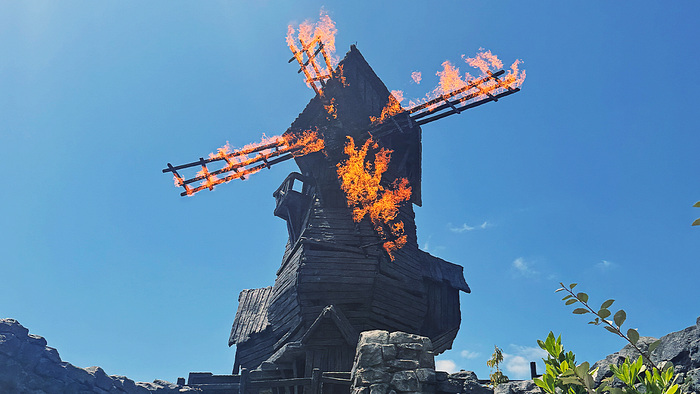
Dark Universe’s success on a macro scale can be attributed to the individual quality of its components on a micro level, with general theming perhaps being paramount in this regard. Darkmoor is among the most aesthetically ambitious and impressive theme park lands I’ve ever had the privilege of experiencing, with its ominous, almost dilapidated stone buildings giving the town a distinct 19th-century European feel. Frankenstein Manor, the show building for Monsters Unchained: The Frankenstein Experiment, looms over Darkmoor from afar, with the Gothic marvel serving as a foreboding icon that brilliantly helps set the land’s deliberately horror-rooted tone. The Burning Blade Tavern, modeled after the iconic set piece from 1931’s Frankenstein, is the single most visually striking theme park bar I’ve ever seen, with the quarter-hour fire displays giving Diagon Alley’s fire-breathing dragon a run for its money.
These facades and the general architecture provide a base level of immersion that’s only amplified by the meticulous details scattered throughout the land; en route to Curse of the Werewolf (a spinning roller coaster that serves as the area’s secondary attraction), I noticed human foot prints indented in the pavement, with these marks steadily turning more animalstic before transforming into wolf prints and disappearing entirely. There are heads of garlic stacked behind the bar at The Burning Blade Tavern as to protect from vampires. The land’s entry portal itself is teeming with intricacies, with its rusted and weather-aged lightning rod collecting energy that then visibly flows through the land to Frankenstein Manor to fuel Victoria’s experiments; the embalmed skulls of fallen vampires adorn the arcs of the portal, which itself establishes the land-wife motif of succumbing to surrounding nature.
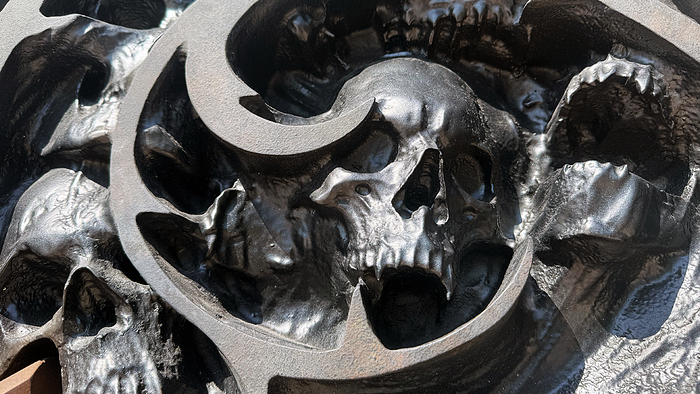
While the area’s broader touches establish superficial immersion, these minute details ensure it, making you feel as though you’ve been transported to a different plane of reality as opposed to an average theme park land. These elements are also imperative to establishing the area’s atmosphere, which, to me, is an aspect integral to a theme park land’s success and longevity; I can forgive deficiencies with regard to attractions or supplementary offerings if the energy and general feel of an area are palpable enough to persuade me to spend time simply basking in their existence. This is a category in which Dark Universe thrives, with its tone, character, and general spirit feeling wholly unique within a theme park setting; while still accessible for all age groups, the land’s components deliberately work together to make you feel a bit uneasy as you walk through Darkmoor, an all-encompassing sensation I’ve never before experienced in a permanent theme park offering. I could happily spend all day indulging in Dark Universe’s energy even if I found its attractions underwhelming — get me a Reaper’s Reserve (the land’s surprisingly wintry, but still enjoyable, exclusive beer) and let me watch the frequent streetmosphere, and I’m all good.
‘Underwhelming’ is the last word I’d use to describe the land’s rides, however, as Monsters Unchained: The Frankenstein Experiment is the most impressive theme park attraction I’ve been on in quite some time. A dark ride that employs an enhanced version of the technology utilized on Harry Potter and the Forbidden Journey, the E-ticket raises the ante with each successive scene, resulting in a state-of-the-art package that redefines the standard at a domestic theme park. While perhaps not as intense as Forbidden Journey with regard to physical movement and range of motion, Monsters Unchained is infinitely more immersive and technologically impressive than its KUKA arm predecessor (which, as a staunch Forbidden Journey fan, is praise I don’t give lightly), as the animatronics throughout are lifelike to the point of troubled comprehension; the attraction seamlessly blends its usage of physical props and screens to create a wholly enthralling experience, with the photo-realistic animation in the screen scenes, in particular, looking natural and harmonious within the story as opposed to a cost-cutting measure.
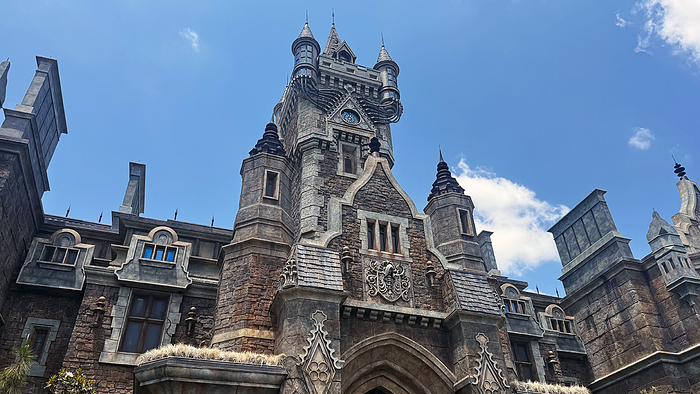
The attraction’s unabated excellence starts in the queue, which is one of the most impressive and elaborate I’ve ever waited in (disclaimer: Harry Potter and the Battle at the Ministry was down throughout most of my visit, and I was, thus, unable to ride). Guests enter the architectural triumph that is Frankenstein Manor and walk through its intricately themed rooms that provide awe by way of detailing and scale, ultimately coming across a deliciously Gothic grand foyer that features a curved staircase and an unsettling mural that augments the feeling of apprehension. This soon leads to a dark room lit only by the land’s aforementioned flowing energy and a two-part pre-show, the second half of which alone justifies the price of admissiont; it’s in the introduction’s latter portion that an uber-convincing Victoria Frankenstein animatronic explains the ride’s premise, introducing a nine-foot tall Frankenstein’s Monster figure that walks toward the audience and expresses a distaste for Dracula, Victoria’s “ultimate challenge” whom you are here to help experiment on.
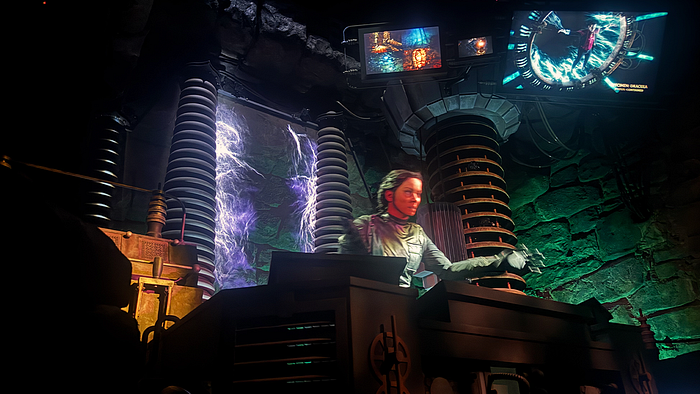
These animatronics are two of the most captivating I’ve ever seen in person, moving with the fluidity and grace of breathing individuals; they’re just as technologically impressive as the Na’vi Shaman seen in the climax of Na’vi River Journey at Disney’s Animal Kingdom, with Frankenstein’s Monster, in particular, perhaps taking the cake given its forward motion capability. This isn’t the end of Monsters Unchained’s proverbial bragging with regard to animated figures, as the ride itself features upwards of 10 animatronics that, again, move with almost incomprehensible fluency; they’re lifelike to the point of commanding your undivided attention, preventing you from appreciating the simultaneous scale and intricacy of the surrounding theming until subsequent re-rides.
I won’t delve too heavily into the attraction’s narrative specifics as to prevent spoilers, but it’s a cohesive, easily trackable story that, while enhanced by prior knowledge of Universal’s catalogue of Monster films, is accessible and engaging regardless of your relationship with the franchise; my sister, whose sole connection to the Monsters IP is the Brendan Fraser Mummy movies, experienced this attraction with me, and she was able to piece the story together solely through information conveyed both in the queue and on the ride itself. The attraction’s stark lighting, eerie large-scale props, and brash Danny Elfman score combine with its animatronics and adept usage of screens to craft a singular, rather intense, and distinctly horror-rooted experience that I suspect will please Monster fans and adrenaline junkies alike; it’s truly an unparalleled attraction that no comparisons would do justice, and while I’m not sure it’s suitable for younger children, I feel it’s thrilling and narratively accessible enough to resonate with general audiences.
Curse of the Werewolf is yet another success, albeit not as categorical of one as Monsters Unchained. A moderate-speed spinning roller coaster that… spins and goes at a moderate speed, Curse of the Werewolf is deceivingly intense, featuring several intentional rollbacks, constant rotation, and occasional airtime. The queue is also well-themed, making for a generally cohesive and enjoyable package for those who want a more traditional theme park experience to counterbalance Monsters Unchained; that said, the ride’s biggest issue is that it shares a land with one of the most immersive themed entertainment attractions in recent memory. The theming isn’t as intricate as that of its neighbor, nor is its narrative as clear, its technology as innovative, or motion as intense; it certainly justifies its existence, but it’s comparatively lackluster.
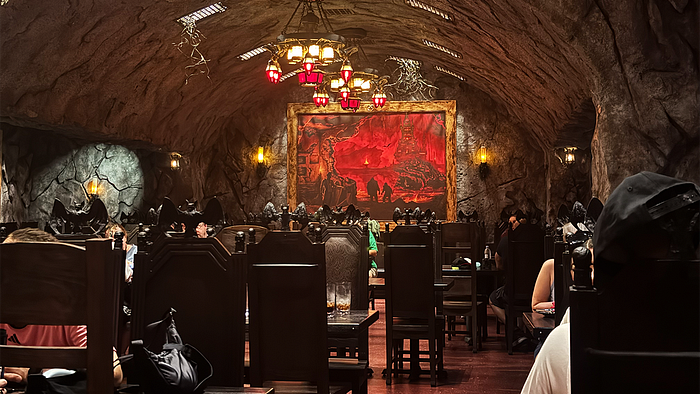
If your stomach is still in place following your face-to-face encounter with Dracula or rotary trek on Curse of the Werewolf, you can grab a bite at either of Dark Universe’s two quick-service eateries, both of which are impeccably detailed, wholly immersive options that augment the land’s brooding tone. Das Stakehaus is perhaps the more ambitious of the two, as no leaf went unturned in its design; situated in the land’s central ‘town square’ area, the restaurant features stunning rockwork that makes you feel as though you’re eating in a secluded, otherworldly setting, with its details both grand (gloomy lighting, chilling light fixtures, general decor, etc.) and minute (black silverware, bat-and-skull adorned chairs that weigh no less than 15 pounds, etc.) giving the venue an eerie, almost uncanny atmosphere. The menu boasts a litany of themed dishes (a hamburger on a black bun and fried chicken wings with a black glaze, to name a few), and while the food quality isn’t industry-shaking, I appreciate the evident thought that went into the offerings.
The Burning Blade Tavern is the land’s supplementary dining option, and while it offers light fare, it’s more overtly a bar than it is a restaurant. It’s here where guests can try several land-exclusive mixed drinks or the aforementioned Reaper’s Reserve while basking in the medieval Europe-esque setting, all while standing inside of one of the most iconic structures in horror cinema history; while not as lavish as Das Stakehaus, it’s still well realized, with its standing as a bar that helps progress a narrative holding a special place in this author’s themed-entertainment-and-beer-loving heart. You should also carve out time to watch the windmill’s blades erupt in flames (which happens every quarter-hour), as it’s a truly impressive sight that, to me, epitomizes the beauty of theme parks.
The thought I keep coming back to as I reflect on my scant time at Dark Universe is that it feels like the execution of a deliberate artistic vision; you can see the extensive work that went into crafting the land’s narrative and the thought attributed to how each of the area’s elements would progress it, with this intent manifesting visually at every turn. It’s, to me, Epic Universe’s most effective world in terms of telling a coherent, meticulously-planned story, and I can’t wait to spend more time in the land piecing it together.
I also appreciate that the land is broadly approachable while still featuring references, both overt and subtle, to the Universal Monster films of old, giving fans of the franchise more than enough to chew on as they walk through Dark Universe. These nods are sometimes undisguised — the Burgomaster’s stand from Frankenstein can be seen in central Darkmoor, there’s a sign referencing The Lion’s Head pub from The Invisible Man, Monsters Unchained borrows several lines of dialogue from the films, etc. — but what I found more impressive and heartfelt were the subliminal, more thematic homages. Several of Universal’s classic Monster films meditate on themes of power, control, and man’s desire to play God, in many cases holding a mirror to the audience and subconsciously asking which of the films’ characters are the true villains; these ideas are not only explored, but sewn into the very fabric of Monsters Unchained: The Frankenstein Experiment, with one character on the attraction even asking “who is the true monster — the one in chains, or the one who put them there?”
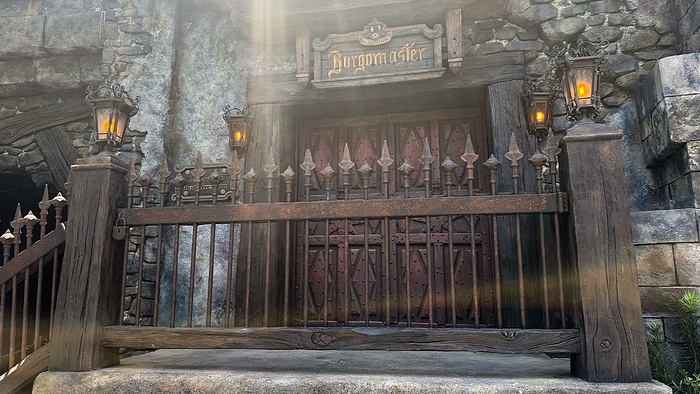
It’s these more thoughtful details that, in addition to complementing the unconcealed references, illustrate not just a superficial understanding of the Monsters IP on behalf of Universal Creative, but a deep appreciation for and adoration of the seminal franchise. The characters at the center of the series helped popularize a genre that’s now a Hollywood linchpin, and as a fan of the brand, I appreciate that its themes are now being presented to new audiences some 90 years later through a new, more tangible medium. Dark Universe accomplishes exactly what a themed entertainment setting based on an IP should do — it captures the essence of the brand, its ideas, and its characters while still being broadly accessible; those who have seen all ~30 of Universal’s Monster films may gawk at the subtle references throughout the land, but those who haven’t will be equally captivated by its atmosphere, theming, and general offerings.
I genuinely love the vast majority of Dark Universe, as I’ve truly never experienced another theme park land quite like it. There’s a simultaneously synergetic and kinetic energy to the area, as all of its components work together to tell an engaging, surprisingly layered story. Its atmosphere is wholly distinct and augments the tone of the overarching narrative, with its attractions and auxiliary offerings making it a place that themed entertainment and horror enthusiasts alike will simply want to exist in. It strikes the delicate balance of being spooky, but not inapproachable, of paying necessary respect to the franchise on which it’s based while not isolating audiences by being too esoteric.
Epic Universe is itself an accomplishment, but Dark Universe, to me, is its crown jewel, as it, in addition to featuring immaculate theming, a singular atmosphere, and an attraction exemplary of the inherent potential of theme parks, tells a coherent story and effectively immerses its audience in the center of it. The beauty of themed entertainment, to me, is the ability to experience well-realized settings and stories that fall beyond the bounds of reality; Dark Universe flourishes in these categories, and I pray that general audiences will resonate with it as deeply as I did.
Dark Universe isn’t flawless.
As I alluded to earlier in this piece, it’s an, at the moment, thoroughly impressive feat that has the bones of a potentially industry-defining land, but it’s not there quite yet, with its footprint perhaps being its most conspicuous blemish. What’s currently present is awe-inspiring and, in my opinion, sits atop Epic Universe’s proverbial apex — it’s just not there in abundance.
The land is just too small; at times, it even feels compact. Guests walk through the entry portal and onto a winding path past catacombs and a graveyard, with this trail quickly leading them to central Darkmoor; this is an aesthetically engrossing entry area that immediately establishes the land’s tone, but you’re into the heart of the area within just a few steps. Both of Dark Universe’s attractions lie just past this quasi-town square, with The Burning Blade Tavern situated a bit further behind them. All of these offerings are themselves compelling, but if one hits the park on a light day, they could theoretically experience both rides, meet a character, and grab a meal within a few hours. If you’re not there with the explicit intention of experiencing the breadth of Dark Universe, you could quickly find yourself with little to do in the area.
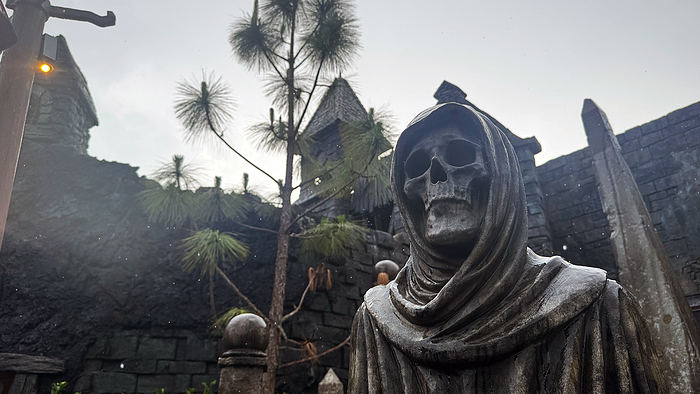
I’m not even expressing this concern as a greedy Monsters fan who wants more of Epic Universe’s acreage devoted to my preferred IP — I’m raising it as a hypothetical consumer who spent thousands of dollars on an Orlando vacation and, thus, wants to recoup my investment in the form of tangible experiences. Dark Universe’s strengths become prevalent the longer you bask in its atmosphere, engage with its auxiliary offerings, and uncover its story, and while I genuinely believe that general audiences who take the time to immerse themselves in the environment will find it enjoyable, I’m not sure if families visiting a brand new theme park on a condensed timeline will find the hours necessary to do so. The area is competing for attention with lands based on three of the most iconic family media franchises of all time (all of which have just as much, if not more, to do); I, frankly, wouldn’t blame parties if they devoted more considerable time to those worlds despite my obvious thoughts on Dark Universe’s quality.
The immediate way to combat this issue is to sustain the streetmosphere and maintain the area’s malleable feel, though Dark Universe, admittedly, isn’t the only Epic Universe world to boast such entertainment and attributes. Expansion is a potential long-term solution, and while this is a rather funny point to be raising before the park’s official opening, a Creature from the Black Lagoon boat ride is rumored to be coming to the land in the (potentially) not-so-distant future; such an attraction is even alluded to in the Monsters Unchained queue, with a visible newspaper featuring a story about an “amphibious humanoid” capturing a Darkmoor woman named Kay Lawrence.
Forgot to upload earlier this week but here’s the Visalia Harbinger article in Frankenstein Manor (what can be read, at least)! Any chance we can see the whole article? @G_Prodigy @UniversalORL pic.twitter.com/hjODGvZMV9
— 🌠Frequently Fearing Yorg🌠 (@WhatsAYorg) April 19, 2025
A Creature dark ride makes sense for a bevy of reasons, with Epic Universe’s general lack of a traditional boat ride being paramount among them. Both of Dark Universe’s current attractions are also quite intense, and the land could, thus, use a more broadly accessible third offering to please younger guests while diverting crowds from Monsters Unchained and Curse of the Werewolf; given these parameters, a boat ride leveraging the enduring popularity of Gill-Man seems like an excellent concept. It’s also encouraging to see that Universal Creative is already remixing the plot of the 1954 Creature from the Black Lagoon film to better fit Dark Universe’s narrative; in the original movie, Kay Lawrence is a scientist who embarks on an Amazonian expedition to investigate word of an ancient amphibious creature, but within the context of the land, she’s canonically been established as a Darkmoor native.
My other gripes with Dark Universe are more nitpicky in nature, as though I don’t care for certain elements, I’m not sure how they could’ve been practically avoided. The gaudy black netting that surrounds almost the entirety of Curse of the Werewolf is the most pertinent example of this; I understand why it needs to be there from a logistical standpoint — the ride has several sections in which guests hang over pathways for prolonged periods, and you need a net overhead for safety reasons — but the simple black netting looks out of place when juxtaposed against the immaculate theming consistent across the rest of the land. It doesn’t necessarily thwart immersion, but it just seems like a makeshift fix for a design oversight.
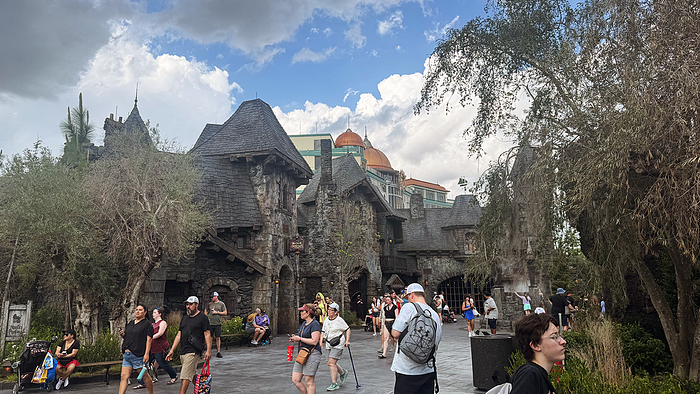
I realize I’m putting myself at risk of sounding like a themed entertainment snob, but sightlines are a slight issue in the land, with the ultramodern Helios Grand Hotel looking incredibly out of place as it looms overhead from outside the entry portal. There, again, wasn’t much that Universal could’ve done to avoid this issue, and the sightlines problem isn’t unique to Dark Universe; that said, it’s a bit jarring to see a pristine 500-room hotel towering directly behind quasi-decaying stone buildings.
And that’s where my criticisms of Dark Universe largely end, as it’s one of the most exhaustively conceived, well-realized theme park lands I’ve ever set foot in. The land’s primary and supplementary offerings intersect to place you at the center of an encompassing, immersive narrative, with its atmosphere, architecture, attractions, and attention to detail making it one of the most enthralling and thoroughly captivating themed entertainment settings I’ve ever visited. It succeeds as a physical representation and celebration of Universal’s structural IP, and I feel there’s enough throughout to entertain general audiences — and create new fans of the Monsters — if they’re willing to devote ample time to it. The land’s most notable problems can be fixed with sustained investment and care, and while I believe Dark Universe will be more robust and generally better several years from now than it is today, it’s, in its current state, a singular, genuinely remarkable themed entertainment triumph that I couldn’t recommend more profusely.
Be sure to continue to follow Boardwalk Times for more coverage of Universal Destinations & Experiences.
Support Boardwalk Times on Ko-Fi.
Support Boardwalk Times by shopping on Boardwalk Store:
If you like this article. Subscribe to my free newsletter Boardwalk Times: Stories from the Seashore, a monthly dose of Disney, its businesses, and the wider themed entertainment industry.
Kyle Silagyi is a columnist for the Boardwalk Times