
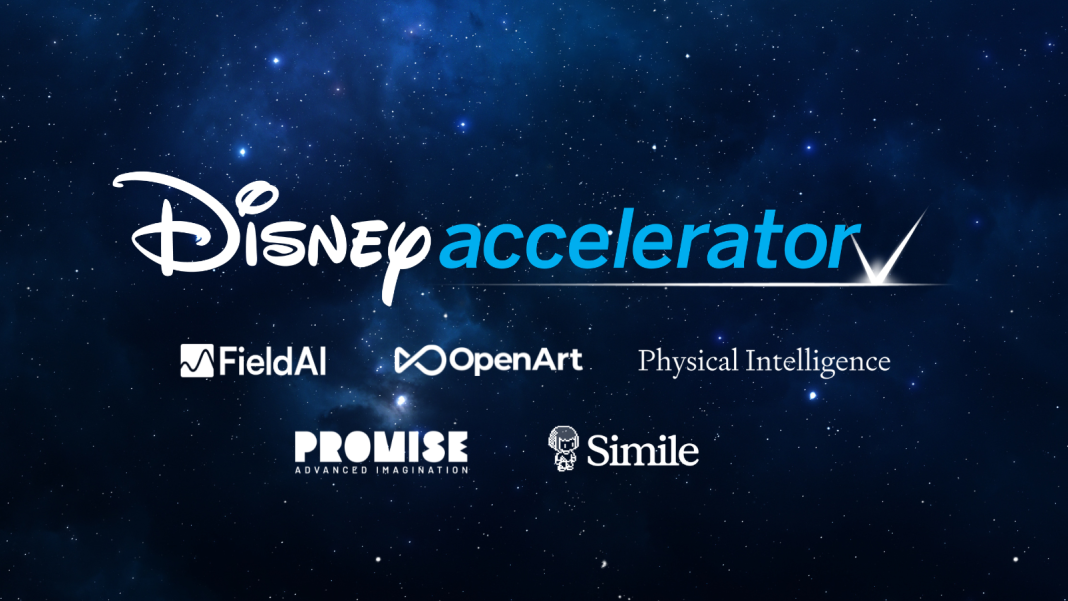
Disney Accelerator has revealed its 2026 cohort.
The innovation and development program provides growth-stage companies with investment capital and the opportunity to collaborate with The Walt Disney Company.
Past Disney Accelerator companies include Epic Games, Camp, Kahoot!, SambaTV, Atom, Eleven Labs, Sphero, Attentive, StatMuse, StatusPro, AudioShake, Animaj, Haddy, LIMINAL Space, and The VOID (RIP).
Here is now a deep dive into the companies that make up the Disney Accelerator 2026 cohort.
FieldAI
FieldAI builds foundation models that enable robots of many types to operate safely in dynamic, uncertain environments without prior maps, GPS, or pre-planned routes. General-purpose robots capable of a wide range of tasks have been deployed commercially across hundreds of sites on three continents.
Physical Intelligence
Physical Intelligence (Pi) is developing general-purpose AI for the physical world. Its foundation models are designed to enable robots and other machines to perform a wide range of tasks, rather than relying on task-specific programming.
Promise
Promise is an AI-native studio that develops film, series, and visual effects by empowering next-generation storytellers. MUSE, its flagship studio operating system, integrates GenAI into all stages of production to support human artistry and expand creative possibilities.
OpenArt
OpenArt is reimagining fan engagement with generative AI, empowering creators to bring their visual stories to life while protecting IP. The platform allows users to conversationally create, or “Vibe Direct,” ideas, characters, and stories using state-of-the-art, rapidly evolving models.
Simile
Simile is pioneering the field of AI-based simulation, building a representation of the world grounded in real human behavior. Their foundation model enables organizations to explore consumer insights before making decisions.
Our Quick Take
This year’s cohort spans key strategic innovation areas across Disney: helping robots operate safely, enabling creatives to leverage AI, opening up new forms of fan engagement, and gaining deeper insights to better serve guests and fans. The goals all serve Disney’s various lines of business. This is the heaviest AI year yet for Disney Accelerator. The program has leaned into AI companies in the past, but this year each company has an AI angle.
FieldAI is redefining general robot intelligence, and the company is built by veterans of NVIDIA, Google DeepMind, Amazon, Tesla, NASA, and others. It’s no wonder Disney would be intrigued by this company, considering Walt Disney Imagineering R&D already works alongside NVIDIA and Google DeepMind when it comes to free-roaming audio-animatronics. FieldAI also has solutions for several different industries such as construction, mining, manufacturing, agriculture, and more. Walt Disney Imagineering wants to eventually populate new lands with free-roaming robotic characters. Within Disney’s description of FieldAI, this line sticks out: “[robots] operate safely in dynamic, uncertain environments without prior maps, GPS, or pre-planned routes.” This would likely solve a few issues for Disney as they continue to deploy more advanced audio-animatronics in its parks and destinations across the globe.
Physical Intelligence is creating foundational models that are designed to enable robots and other machines to perform a wide range of tasks, rather than relying on task-specific programming. You can already tell how that would be useful to Disney, which is already in the robotics/audio-animatronics game. Some examples on Physical Intelligence’s website include a robot folding clothes, cutting zucchini, and taking out the trash. There have been other research case studies like robots having to remember timers while cooking and more. Before landing in the Disney Accelerator program, Physical Intelligence has been backed by Jeff Bezos, OpenAI, Thrive Capital, and many others. Could Physical Intelligence collaborate with Walt Disney Imagineering R&D to create foundational models that would make certain character audio-animatronics remember certain tasks and gestures without it being programmed or controlled in advance?
Promise is an entertainment studio built for the GenAI era. Promise’s MUSE, its flagship studio operating system, integrates GenAI into all stages of production to support human artistry and expand creative possibilities. I definitely think every single Hollywood studio, including Disney, is exploring AI as a way to reduce visual effects costs. Promise CEO George Strompolos wrote a note on how much it means to him to be selected for the Disney Accelerator program. Promise is backed by Peter Chernin’s North Road Company, Andreessen Horowitz, Google, Michael Ovitz’s Crossbeam Ventures, and more. On the surface, there are a lot of potential collaboration opportunities for Promise within Disney’s ecosystem.
OpenArt is a generative AI fan engagement platform, but it also features various use cases. The platform is quite robust, and there are a lot of capabilities within OpenArt. While just taking a glance, OpenArt offers tools for marketing & advertising, films & stories (storyboards), music videos, animation & illustration, UGC social media content, micro drama, anime, gaming, explainer videos, and mood & atmosphere. The platform does require payment, though, but I am curious to see what Disney is going after here. Do they like OpenArt’s AI models, or do they potentially see the platform as something they could integrate directly with Disney+? Basically, instead of OpenAI doing the AI features for Disney+, maybe it’s actually going to be OpenArt? OpenArt also acknowledges that they protect creators’ IP as well.
Simile is pioneering the field of AI-based simulation, and allowing organizations to look at consumer insights before making decisions. This could line up for various businesses across The Walt Disney Company. Simile has been utilized by professional services organizations like Deloitte and Gallup. To me, Simile is the biggest wildcard out of the entire Accelerator class; however, I could potentially see their collaboration with Disney being based around Josh D’Amaro’s OneDisney initiative. We know Disney has so many different data points; could a company like Simile tie it all together?
This year’s program will culminate with the 2026 Disney Accelerator Demo Day on the Walt Disney Studio Lot in early November. It will truly be fascinating to see what FieldAI, Physical Intelligence, Promise, OpenArt, and Simile bring to the table. Throughout the years, we have seen Disney Accelerator companies make an impact and have also seen others fade away from the consciousness of the Mouse House.
Support Boardwalk Times
Be sure to follow Boardwalk Times for more coverage of The Walt Disney Company.
Zach Perilstein is the Editor-in-Chief of Boardwalk Times