
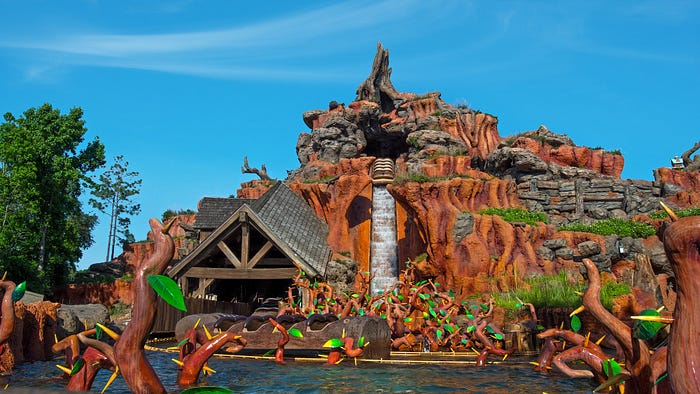
UPDATE: This article has been in the works for a while now. I stand by the conclusions, but I’m happy to say that Disney has decided to move forward with a Princess and the Frog retheme of the attraction. I think my claims about Author Intent, Audience Interpretation, and Artistic Message still stand, but no longer is it necessary to debate replacement when the plans for redesign have already been set in motion. I’m excited to see what the future holds, and I hope that the finished product is just as beautiful as the source film.
To start, one thing must be made clear. I’m a white, middle-class man who has never been discriminated against as a result of my race. I have never felt the pain of seeing my heritage, culture, or community stereotyped in popular media to reaffirm biases held by those in power. It would be wrong to contextualize this within my experiences, as it will only undermine the difficulties faced by the many innocent people of this nation. My privilege is found in the ability to approach art from an apolitical stance, which I will actively avoid in this article for the sake of representing the issue.
Recent discussions across the internet have asked brands to turn a mirror on their properties and reflect on the ways they’ve profited from years of systematic and internalized racism. Across the board, a call to action has forced corporations holding the wealth and power in our society to move forward with the marching step of progress or be lost to the wrong side of history.
Just today the Quaker Oats brand announced the end of their Aunt Jemima brand, a breakfast syrup that based its iconography on Billy Kersand’s 1875 minstrel song “Old Aunt Jemima.” Blackface performers inspired the formation of the brand, and it has been a cultural mainstay in the United States since its inception. For decades, Amerian consumers had been topping their hotcakes with a brand inspired by deeply racist post-slavery caricatures of Black Americans. In fact, consumers at Disneyland between 1955 and 1970 had the chance to meet the brand’s mascot at a themed restaurant in New Orleans Square. (Additional Reading about Aunt Jemima and Racist Caricatures in United States History)
It’s becoming clear that consumers no longer feel comfortable supporting groups with a checkered past. Boycotts have been called for Chic-Fil-A and Yum! Brand Restaurants after their donations to Anti-LGBTQ+ charities became public. No longer is speech limited to word, but also to the way profit is spent. If a business acts in a regressive manner, consumers speak with their wallets and deny the corporation further revenue without striving for meaningful change. We’ve seen the strength of consumer backlash with the collapse of the online food entertainment group Bon Appetit due to unfair hiring practices, unequal compensation, and limited representation of diverse culture within their media. The voice of the consumer is no longer one of desperation, but of meaningful power. If the brand performs negatively, it is no longer the consumer’s job to adjust their expectations, but the corporation’s duty to note the issue and reflect accordingly.
As we turn our focus towards Disney, we begin to recognize a small but vocal movement against one of Disneyland and Walt Disney World’s most famous attractions. Amidst the calls for brands to distance themselves from problematic pasts, some entertainment consumers ask that the company reevaluate Splash Mountain, a log flume based on the 1946 animated Disney film Song of the South. The controversial nature of this movie requires no introduction, but the question over how Disney should respond to the crowd’s criticism is left unanswered.
I’d like to use this article to discuss a few things. First, a small background on the attraction’s cinematic origins. I find this movie to be undeserving of a watch, but important to the discussion of the attraction. Second, I’d like to talk about the attraction itself, and the unique position Disney finds itself in when attempting to define the exact issue with Splash Mountain. Finally, I’d like to conclude with a discussion on contextualizing literature as a whole, and the balance between respecting intent and understanding the effects media can have.
I would like to reiterate that I in no way intend to devalue people’s experiences with the source material. In fact, I may as well state my thesis here. If Disney can change the attraction, and a strong argument for the attraction’s problematic nature can be developed, then Disney has no reason not to oblige to these demands. It’s just a ride, we will live without it.
Song of the South
Most of the information I present will be incredibly surface level. The film has necessary details that need to be discussed when contextualizing Splash Mountain, but I don’t necessarily think that all of it needs to be covered here. That being said, Shawn Rosell did a fantastic dive into the subject on his YouTube channel. I highly suggest that everyone reading this watch that video before moving forward.
The general gist of the situation follows from the sanitization of African American hardships after the civil war but before the civil rights movement in 1954. The film fundamentally ignores the deeply horrifying truths of slavery in favor of something more akin to the romanticization Gone With the Wind’s romanticization of the Southern lifestyle. Some may be quick to say that Disney films are for children, but this perspective fundamentally neglects the effect media can have on the youth. Imagine that instead of being based in the post-war south, this film was an incredibly lighthearted depiction of how pleasant life could be in the Nazi concentration camps. Maybe some of the prisoners sang in tandem with a happy bluebird, talking about how wonderful the day of a starved worker could be. They would get along wonderfully with the S.S. as if the preceding war had never occurred. The Holocaust may have been a deeply traumatic event in history, but with a little elbow grease, a pleasant narrative can arise from this pain.
If you found this comparison disgusting, you can see exactly how inappropriate the depiction of post-slavery race relations is in Disney’s picture. No matter the justification, the film shows a blatant disregard for the truth in pursuit of sanitized history. Ignoring the pain of slavery both inflicted on the people of the past and the lives of their descendants and community in pursuit of entertainment is ignorant, and deserves the criticism it has received in the popular zeitgeist. Any call for this film’s rerelease is frankly embarrassing, as consumers put their brand loyalty before their moral compass.
The film is comprised of two parts, starting with the live-action part of the film focused on Uncle Remus’s (James Baskett) interactions with the plantation owner’s grandson Johnny (Bobby Driscoll), who had escaped from his family following a minor dispute. Uncle Remus brings Johnny back to his cabin to tell him the story of Br’er Rabbit, where the story transitions to animation. Song of the South proceeds to retell three of Joel Chandler Harris’s stories, those being Br’er Rabbit Earns a Dollar a Minute, The Tar Baby, and The Laughing Place. This turns what was once a collection of oral stories told by slaves as a form of rebellion into a timeless (and raceless) tales of overcoming mild impediments.
There does exist some truth behind Joel Chandler Harris’s writings. Though not looked upon positively in a modern context, it’s true that Harris’s intentions as an author were not to further racism or the racial divide present in the country’s culture. Rather, he aimed to record stories he had heard on the Turnwold plantation and introduced them to Americans as a way to bridge the gaps between newly free Americans and the white folk who were in an outrage over the abolishment of slavery. There is a strong argument to be made that he profited off of the creative work of the unheard and that his attempt to faithfully capture dialect comes off incredibly offensive to modern audiences, but the fact that the original stories presented a cultural narrative when the Disney interpretation did not is worth mentioning.
No matter the attempts to retell genuine stories from the time of slavery, there is an undeniable presentation of an idyllic master-slave relationship (even if the movie takes place after the abolition of slavery) that retroactively ignores a serious problem in American history. Walt Disney’s love of Lincoln must’ve influenced the support of abolition, but his patriotism limited the scope of which he could criticize a country that has continuously done their people wrong.
Knowing this, it was a bold move to adapt this film into a theme park attraction, to say the least.
What to Do with Splash Mountain
Hopefully, anyone who’s reading this has not read the Twitter threat by @DoctorOw. His history of Splash Mountain was wildly inaccurate to an embarrassing extent. For some background on the development of the attraction, check out this thread here, sourced from Sam Gennawey’s book The Disneyland Story.
Before discussing Splash Mountain, I want to tell a small story about another famous Disney attraction that was analyzed under a modern context following minor backlash. This won’t take too long, but I hope you see that there’s a reason why we revisit old concepts to ensure their message remains in line with that of the culture at large.
In 2018, Disney revisited one of their classics and refurbished Pirates of the Caribbean to ensure relevancy to modern audiences. When the attraction opened, the artistic intent was to describe a horrifying world overtaken by pirates and juxtapose the crimes performed in life with the unavoidable truth that is death. As the viewer descends into the world of piracy, they’re faced with the place where all pirates end up. Whether with their riches or devoid of a legacy, all of these criminals spend their eternity in Davy Jones locker. These criminals ransacked and pillaged for personal gain, but could take none of these treasures with them into the afterlife. After all, dead men tell no tales, right?
However, the merchandising department saw an entirely different beast. The Imagineers tried to design an attraction where you quite literally dive into a hellscape controlled by these jovial demons, but marketing recognized that children admired the pirates rather than fear them. New merchandise allowed kids to wear the “cool” pirate “heroes” costumes. Soon, the original narrative of the attraction became incongruent with the audience’s interpretation. There was no critical analysis that questioned whether mindless crime in life is justified in a world where legacy turns sour with death.
The Gore Verbinski Pirates of the Caribbean films only furthered the divide between intent and interpretation. Jack Sparrow was a criminal, but a loveable one that children could look up to. No commentary was given to disincentivize the Pirate lifestyle. In fact, it glorified a lawless life at sea, fighting for what is right rather than the sins of reality. Children continued to purchase merchandise en masse, glorifying a life of unrestrained crime in the corporate, sanitized sense.
This left Disney with a problem. After years of marketing to the childish dream of lawlessness, they could no longer ask audiences to question the ethics of this lifestyle. Scenes where Pirates attack women, enslave innocent people, and torture political officials needed to be recontextualized under the corporate narrative. These pirates aren’t monsters, rather, they’re fighting for what is right and act a bit silly in the process. The introduction of a Jack Sparrow storyline undermined the original narrative by giving most of the pirates justification of “inter-occupational strife” for their presence. When certain scenes outside of the storyline remained problematic with the company’s glorification of piracy, the company had further revisions to do.
So, in 2018, the attraction was updated once again to remove the auction scene, which originally depicted the sale of enslaved women to pirate suitors with an incredible bout of misogyny. The original goal of this scene was to elicit fear, showing how disgusting the Pirates lawlessness and lustfulness truly are, but the sanitization of the Pirates’ images renders this scene more comedic than powerful. It’s undeniable that the original scene featured some morbid comedy (focusing on how attractive you need to be a valuable slave), but the thematic undertone of disgust was eventually lost after years of promoting the lifestyle rather than criticizing it. The new scene is fundamentally uninteresting, poorly written, and bland, but lacks the ambiguous theming of the scene it replaced.
What’s important though is the narrative the scene attempts to convey. The auction scene might be a classic, but even the most forgiving interpretation following the Johnny Depp refurb must accept that it treats the enslavement and sale of women as a comedy. The rest of the attraction refuses to look critically on the actions of pirates and as a result, this scene can do nothing but treat the pirate’s actions as comical and in a sense, justified. The scene was now incongruent with the rest of that attraction’s narrative.
This leads to a discussion of intention. The intention of the auction scene in Depp Pirates was to derive comedy from the slavery of women. The intention of Joel Chandler Harris’s stories was to capture and distribute real folklore told by slaves in the antebellum south, primarily those that subtly shared revolutionary ideas in a manner that would go undetected by slave owners. The intention of Song of the South is to sanitize these stories, removing the context of slavery to appease white audiences. Instead of treating Harris’s stories as valuable pieces of history arising from the hardships of forced labor, Song of the South recontextualizes them as broad life lessons applicable to a white audience. In doing so, it denies the South’s horrific past, and in turn, the plight of the Black American. That’s what makes Song of the South egregious. The film sanitizes valuable stories while bringing an original live-action aspect that brands the black and white relationship post-war as one devoid of conflict. It ignores racism and wears that interpretation on its sleeves.
Splash Mountain retells the animated segments of Song of the South (and in turn the stories of Joel Chandler Harris) without referencing any of the film’s live-action segments (aside from an Uncle Remus quote in the queue). All three of the aforementioned Harris stories are represented, with The Tar Baby being retold to have Br’er Rabbit encounter a beehive instead. Uncle Remus has been ultimately replaced with Br’er Frog, who narrates the story throughout the attraction.
This is where I ask the value of intent when analyzing a piece of media’s problematic nature. I fundamentally understand the hatred for Song of the South, but only because it intends to depict racism in a light that ignores the deeply painful reality of the issue. Intent influences the message, and if the piece of art reflects a morally questionable perspective, we should engage in a discussion about deplatforming that media. As I noted previously, it makes sense to deplatform the deeply sexist message of Pirates, as continuing to glorify this human rights violation only perpetuates sexism in the cultural zeitgeist. The original intent of Pirates may have provided adequate context for the auction scene, but further redevelopments in the art inadvertently created a message diminishing the value of slavery. There is no criticism in these pieces, only the perpetuation of oppression.
I do find Splash Mountain a little bit different though. The connection to the racist source material is undeniable, the 1946 Disney film is embarrassingly tone-deaf, but the attraction fundamentally lacks the problematic message of the film. Much of the issues from the movie arise in the relationship of Uncle Remus and the lead white family; something wholly absent in the attraction. The Harris stories are represented, but fundamentally lack any of the subtexts from the film while seeing changes to the narrative to avoid any problematic depictions. They may have been used in an incredibly racist film, but their origins are found in folk-lore. Br’er Rabbit as a character is not racist, rather, the interpretation of the character by Disney in 1946 is incredibly reductive. I do find it fair to have a critical discussion about the “faithful” recapturing of dialect in Harris’s stories, but I think that’s best served for literary criticism and not theme park analysis.
Just like I did with Pirates, it may be valuable to describe the narrative impression the story leaves on the audience. Fundamentally, to a viewer who had just exited the attraction, I do not find it possible to create or reinforce racist ideologies based simply on the material presented. A blind observer engaging with this art will find something with incredibly little substance. There are no meaningful themes displayed in this attraction. Song of the South may have been sanitized, but Splash Mountain has been scrubbed so clean of its origins that the ride is a paper-thin version of its source. Not only does this lack any of the messages from the film, but it also lacks any message whatsoever. Audiences will leave thinking about pleasant music and pretty sets without any knowledge of the problematic source or centuries-old inspiration.
It’s here that I ask the reader to critically analyze the extent to which a material can be problematic when it lacks a message or intent. I understand that we want to limit messages that push an oppressive or discriminatory perspective, but nowhere in this attraction is a central narrative pushed whatsoever. Aside from an appreciation for happiness at home, Splash Mountain has about as much to say as a Tilt-a-Whirl. Viewed on its own, it would be fundamentally impossible to call this attraction problematic.
I do, however, sympathize with people who are learning of the source material for the first time. If you have been riding Splash Mountain since childhood and just now learned of the racist film it’s based on, I can understand the frustration. To realize there’s a connection between a children’s ride and a racist film is surprising, and I understand the knee-jerk reaction that stems from this. The strength of that connection is paper-thin, and might as well be nothing aside from the name of the characters and situations depicted in the folk-lore. It’s a blemish on the attraction for sure, but not a meaningful one when you question how this relationship affected the art at hand. Truly, is the racist narrative in Song of the South present whatsoever in Splash Mountain? Is its influence? Does any part of the ride reflect the problematic aspects of the film?
It doesn’t seem that this is the case, at least, for the most part. I sympathize with people who question the decision to replace Br’er Rabbit’s black voice performance with a white one, especially given the subtext of Br’er Rabbit as a slave outwitting and revolting against the bigger Br’er Bear and Br’er Fox (stand-ins for White Slavers). I also understand the issues with the dialect in the attraction, which feel a little too much like 1940’s white people (or 1800’s) trying to capture a dialect they find inferior. This is a carryover from the original stories that deserve criticism, as what the author intended to be faithful comes off insulting as we recognize his internal biases. The main tune of the attraction “Zip-a-Dee-Doo-Dah” has its origins in a pre-Civil War song that did have incredibly racist variations, but I don’t necessarily know if any of this is captured in the attraction’s main theme. The origins of the song may be evil, but in the modern form, no viewer would be left with a racist message. It’s an interesting factoid for historically minded observers, but a meaningless one when discussing thematic criticism.
I’d like to make a small deviation to make a point.
During World War II, the Germans had an incredibly difficult time importing many of the products normalized before the war as a result of their fascistic actions. Ingredients were sparse, and companies were forced to get creative when developing product replacements. A subsidiary of Coca-Cola (Coca-Cola GmbH) realized that no one was using beet sugar, whey, and apple pomace, so they got a little creative and created a new soda. It wasn’t too popular, many bottles were left over after the war, but it served to fill the void left by the international embargo. When Germany fell, Coca-Cola took over this factory and ended the distribution of the soda. In 1955 however, Fanta resumed production and is still enjoyed by the masses to this day.
I believe this story to be slightly irrelevant but illustrates how drastically a product can be separated from its origins. Volkswagon shares a similar story, being created to support the Nazi army and evolving with time to distance from that history. If you truly believe that Fanta and Volkswagon are impermissible to be sold in the modern-day due to their original support of the Nazi’s I applaud your consistency, but question the reason why. Do these products affirm the same political narrative they did at the time of creation? Do they still push a message based on hate and oppression? Or have they evolved to distance themselves from this and reform under a more progressive standpoint (as progressive as soda can be).
The connection between Song of the South and Splash Mountain is undeniable. The characters, their designs, and the narrative are lifted directly from this problematic film. It would be wrong to deny the history of these characters, but it would also be wrong to say that their modern interpretations perpetuate the same racism that the film did. The messages are unrelated between the two, and to say that they’re both racist is to ascribe the sins of the father to the son. Splash Mountain will suffer for the failures of the original film but actively does not make the same narrative mistakes. There’s an undeniable connection, but only in intellectual property.
Princess and the Frog?
I don’t find any value in this report from THR. It’s clickbait at its purest and fundamentally misunderstands the issue at hand. As usual, they go with what looks best as a headline rather than take any critical look at the issue. However, it does compile a decent backstory on the fan response. Take a look.
Princess and the Frog Splash Mountain retheme for Disneyland thread. Just put on the soundtrack and a splash ridethrough while reading this. pic.twitter.com/8z5wOalyB7
— Frederick Chambers (@HelmsmanFreddy) June 9, 2020
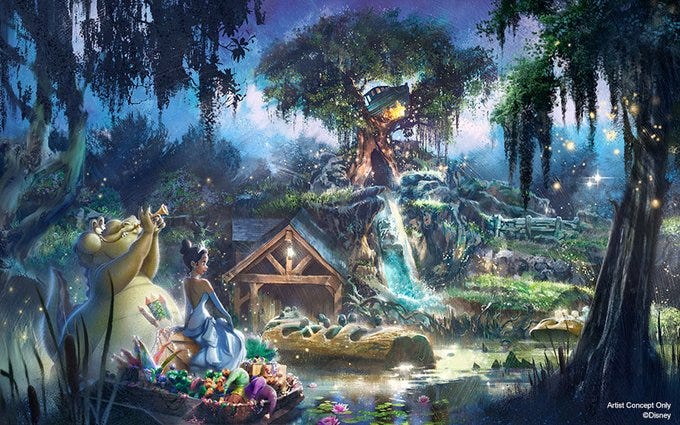
Most of the outcry against the attraction has stemmed from a tweet that hypothesized a world where Disney replaces Splash Mountain with a similar attraction based on Princess and the Frog. The landscape would be changed to mimic the Louisiana Bayou, with the attraction rethemed to Mama Odie’s treehouse in the film. Many make the call to Disney to abandon an attraction based on a racist film and replace it with something more deserving, that being the first attraction in their parks to feature a black lead (Sidenote: Why hasn’t that happened yet? An observer may point to Rise of the Resistance, but I believe most people are asking for an attraction with a Black main character after years of being supporting cast)
First, I do find it necessary to say that I really don’t care if Splash stays or goes. I don’t really like log flume rides, Princess and the Frog is my favorite Disney movie, I think that it’s just a theme park attraction, losing it wouldn’t be the end of the world. Disney can do whatever it wants and I wouldn’t care.
Second, I have no interest in discussing financial problems with replacement. We’re here to talk about the validity of art and the necessity to deplatform media with a regressive message. If the attraction really is as racist as the people say, no amount of money will be too much when asking Disney to replace it.
Finally, Disney’s rules for taking outside ideas are incredibly strict. Just by offering this as an option limits (if not denies) the potential for it to ever come true. This won’t play into my conclusion but should be mentioned so that fans calm their expectations.
One of my first reactions to this call for change is to defend Princess and the Frog. Either the fans on Twitter have been normalized to the pattern of attraction rethemes by the company, or have no familiarity with theme parks, but the idea of this film being introduced to the park through overlay feels insulting. Rethemes are often lazy, cheap, and bland compared to a new project built from the ground up and created to both tell a new story and innovate on theme park technology. Frozen Ever After feels like an 80s boat ride because it is an 80s boat ride. No amount of cheap overlay and tech will change a dated ride mechanic, which is something we’d have to accept if Princess and the Frog were introduced on the foundation of Splash. For such a brilliant film, a retheme would not only be restrictive, it would be embarrassing.
The more interesting response would be to seriously question the narrative pushed by Twitter slacktivists. Instead of forming an original opinion or researching the attraction in question, they see a tweet or TikTok with radical bullet points calling this attraction racist and hop on the bandwagon. It is fundamentally true that Splash takes inspiration from Song of the South, but the manner in which it does so leaves the audience with none of the original film’s message. If I hadn’t engaged with the media, and I saw a tweet confidently claiming that the ride constantly spews vitriolic racism at a children’s theme park, I’d be incredibly angry too. Too often though do we see a tweet and form our opinion around another person’s outrage. Without understanding the fundamental message and audience interpretation of the media, any conclusions we draw are based on sensationalism over fact.
Is an attraction devoid of a problematic message but related to a racist film better than one that’s wholly unproblematic? I don’t think I can answer that question. To do so would call the attraction bad without it having done anything explicitly wrong. Is the character of Buzz Lightyear reminiscent of the euro-centric colonialist mindset that led “explorers” to visit other lands and deem them their own? You could make an argument in favor of this, with a strong foundation to boot. Does this make Astro Blasters a morally abhorrent ride for depicting a colonizing Star Command? I wouldn’t think so. Dumbo’s crow characters have been the center of online discourse, which reference Jim Crow racism using a crow named… Jim. Does this make the Dumbo spinner attraction racist? Not unless it pushes a message reflecting minstrel shows as the film did? If the similarities between attraction and film exist in name alone, then it seems wrong to judge one piece of art based solely on its relationship to the other.
If Disney decides to move forward with a Princess and the Frog attraction I’d be ecstatic! The film has a gorgeous art style, lovely music, and a beautiful narrative. If that’s the direction Disney wants to take the parks, and they can do it in a way that transforms the original attraction more than a simple overlay, they should absolutely move forward with this project. However, I don’t think that Splash Mountain is problematic to the extent that it MUST be removed. If you want to cleanse the parks of anything that reminds you of this racist film I get it, but to say that the attraction itself is racist seems based on unfounded conclusions.
Death of the Author
To conclude this analysis, I’d like to refer to a theory gaining more and more relevance as literary criticism develops in the modern age.
In 1967, Roland Barthes published an essay claiming that attributing a text to one individual inherently places a limitation on the art. I’ve drawn an incredibly simple summary of this work, but it essentially asks the audience to define for themselves what the author had intended to convey, with the conclusion that they cannot definitively say so. It is said then that the value of a work does not come from the author’s attempt to speak, rather it comes from what the text itself imparts on the reader.
I don’t necessarily know if I agree with this, I place a heavy emphasis on the value of an author/director/designer etc., but I do understand the way in which it rebalances literary value from the intention of one to the interpretation of many. An author may have tried to tell a story, but if the text conveys something completely different, it’s in that second interpretation that the piece finds meaning.
An example in the modern sense is Fight Club. Fincher’s film makes it clear off the bat that the goal is to target toxic masculinity and dismantle the social narrative that only weak men express emotion. In a world where men seek alternatives to feeling or expressing insecurities, they turn to violence. However, audiences gravitated toward Tyler’s character, possibly proving Fincher’s point. Men choose directions that limit emotional outreach and maximize bravado as that’s the societal expectation. In a way, the audience interpretation reinforces Fincher’s thesis, but it also shows a fundamental disconnect between creator and audience. Fincher aimed to dismantle male standards, and the audience used the piece to reinforce them.
How does the Song of the South relate to this theory? First, we understand that Joel Chandler Harris attempted to retell stories he heard from his time on a plantation, and used two independent sources to verify what he heard every time. His intention was that of preservation, and audiences at the time found that incredibly enlightening and valuable. Modern audiences, however, see his choice of dialect insulting and question how audiences would perceive the intelligence of black people following the story. Song of the South intends to tell a carefree fable between a former slave and an upper-class white child, where the stories of Uncle Remus teach this white boy how he can fix his own issues. The audience however if they took the film at face value would believe slavery to have been a mild inconvenience, and that black Americans post-slavery were treated well by former slaveowners.
What then is the author’s intent of Splash Mountain? To tell a story about someone looking for adventure outside the status quo, only to find that their “laughing place” was at home all along. We’ve decided though that this intention doesn’t matter, only the potential interpretation by the audience. However, even this seems unproblematic. The audience has no reason to form any racist or discriminatory beliefs as a result of this attraction, as there exists nothing within the narrative to justify this. Thus, it seems that any problematic aspects are assumed by the connection to the source material, not as a result of a discriminatory narrative.
I absolutely understand the desire to delegitimize the legacy of racist media. If we continue to let these narratives maintain relevancy in our popular culture, we allow the narrative to be normalized, and in turn, influential. Do we then turn against Lovecraft Country, a show inspired by the works of the deeply racist H.P. Lovecraft? How about Cuphead, an incredibly imaginative and creative hand-animated video game inspired by the deeply racist Fleisher cartoons? What about Sorcerer Mickey and Fantasmic, which finds its origins in Fantasia and shares the film with the horrifyingly discriminatory centaur scene? Does it ever become possible to recontextualize a piece of media and distance it from deeply problematic roots?
This isn’t to say that I think everything deserves leniency when interpreting the level at which it is problematic. Institutions and corporations that were or are primarily founded upon hurting other people wear those sins for the rest of their existence. Actions performed by a government or group at one time will not be forgiven at a later date due to a change of heart or cultural standards. We cannot erase the problematic legacies of famous figureheads like Jefferson and Columbus as a result of modern recontextualization. This must be made clear, as I believe individuals or groups who built their fame and fortune off the backs of marginalized or oppressed peoples should never be given a chance to avoid criticism. Nor should they be remembered for their successes and not for their numerous misdeeds.
As surveyors of art, I do believe that we can approach the issue of media differently than that of people. Media can commit no action, and thus, the blame lies wholly on the person who introduced it to the world. I think that any criticism levied toward Disney for their sanitized interpretation of the post-war South is fair and just. I do not, however, believe that anything with a vague relation to this material must be viewed as supporting or perpetuating the issues that the former had previously upheld. No matter the author’s intention, I do find it clear that the main focus should be on the message the material conveys and the general interpretation felt by the audience. If we find that a piece of media both espouses a discriminatory message and that the audience could use this message to reinforce discriminatory opinions or form new ones, then we can have a conversation about deplatofrming that message.
In the case of Splash Mountain, I do not find these criteria to be met. The narrative pushed by the attraction is entirely unrelated to that of the source material, and there exists no situation where an audience would experience this attraction and leave with a regressive viewpoint. It may pique their interest in the source material, but it will never express the fundamentally ignorant views of Song of the South.
Educating oneself on the history of our media can both be intellectually stimulating and culturally enlightening. Understanding the history of the media we consume can be a fascinating endeavor, but the manner in which it relates to the content itself seems to vary on a case by case basis. The mental whiplash of learning that your favorite ride as a child has a history in racist filmmaking must be difficult to accept, but simply identifying that relationship says nothing about the themes or message of the art itself. The blurring of the line between sharing a message and origin as a result of social media outrage is understandable but reflects a growing disinterest in engaging with media critically.
Hopefully, I haven’t neglected any viewpoint here. If anyone has been deeply hurt by the narrative in Splash Mountain, I’d be incredibly curious to know what about the attraction itself made you uncomfortable or invalidated a part of your existence. To feel that is a valid feeling, and in the event that this is the case, I’d have no hesitation to join the cause and advocate for the removal of the attraction.
That being said, my allegiance does not lie with a theme park. If the attraction goes away I will not riot. I will not cry. I will not whine of a ruined day or childhood. I will simply recognize that something I once enjoyed had hurt other people and support the well-being of my fellow man over a cartoon themed log flume ride. The flow of blood and tears always outweighs the rushing water of a children’s theme park ride. We mustn’t lose track of this, lest we doom ourselves to oppressive regimes and discriminatory culture for centuries to come.
Ryan Dorman is a Columnist and the Content Director for the Boardwalk Times. He can be found on Twitter at @OpentheDorman, and as a host of the Boardwalk Talk podcast on iTunes.