
It’s inarguable that Disney has maintained success throughout its cinematic pursuits in 2019. Despite the varying degrees of quality, the Associated Press reports that their total intake to be $13 Billion, with general ticket sales to theaters dropping 4.4% from the previous year. Blockbusters including SpiderMan: Far From Home, Star Wars Episode 9: The Rise of Skywalker, The Lion King, Captain Marvel, Aladdin, Toy Story 4, Frozen II, and more showed that the House of Mouse had dominated releases on sheer number and size alone. It’s been a long year, but remember that Disney also had a hand in Maleficent: Mistress of Evil, Dumbo, Ford vs. Ferrari, Dark Pheonix, Ad Astra, Spies in Disguise, and more when recognizing their recent acquisition of 20th Century Fox.
From one side of the aisle, this is fantastic. Disney fans and audiences alike love to see the brand come out on top, and it’s clear that the general moviegoing public has shown their undying support of these franchises. Of 2019’s top ten highest-grossing films, 8 were produced by Disney, 3 from the Marvel banner, and only Joker (9) and It 2 (10) coming from a different distributor (The Numbers).
I recognize that I’m speaking to an audience of devout Disney fans, but is this the direction we want to see the artform take? In a year where ticket sales are falling, do we really want to see complete domination of the theaters by one powerhouse company, endlessly spilling out sequels and remakes to fulfill the economic equation defined to be the most profitable? Despite having eight of the highest-grossing films in 2019, not a single one was a unique property. Each was a sequel or a remake, which might say something more important about audiences than you might think.
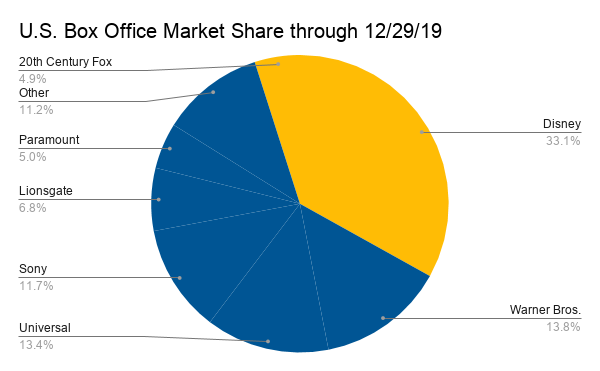
It seems like Disney has cracked the code. If you can create a brand identity homogenous enough, then you can capitalize on the audience’s attention and guarantee impressive returns. According to CNBC, the sum of all Disney brands pulled in 38% of the Box Office earnings in 2019, with their closest competitor (Warner Brothers) only amassing a measly 13.8%, roughly a third of Disney’s. What one might define as success, another would say an impossibly restrictive chokehold on the market. It’s not quite a monopoly, but trends in audience retention show the dismal direction at which these developments will lead.
Disney’s successful year has not been mirrored across the board. Surefire hits by other brands showed miserable results. To name a few, the Warner Bros. Picture Godzilla: King of the Monsters and the Sony sequel Jumanji: Welcome to the Next Level drastically underperformed compared to expectations. Every non-Disney animated film this year had depressing returns, while original films released by other studios suffered similar losses. The data doesn’t seem to make sense; the quality of the film could be high, the advertising equally as impressive, but the lack of Disney’s branding killed everything on arrival.
The most common response to this issue by Disney apologists is to question why their favorite company has shown any wrong-doing in the situation. By their logic, these films make money, and films that make money sell tickets, so it can be deduced that by sheer number of ticket sales, Disney releases the best films. This logic is inherently flawed, as it purposefully neglects the inherent power of an ever-looming brand. Audiences may flock to the theaters for Avengers: Endgame, but that doesn’t necessarily mean that Avengers: Endgame is the best film of the year. On the contrary, it might be the case that Disney’s impressive algorithm behind brand recognition and fundamental foundation promoting constant supply feeding into cultural addiction has pivoted the market in their favor.

It’s been reported that small theater chains are coaxed into giving up screentime for Disney films, which many would advocate they “take a stand against the corporation and boycott this fascistic control.” This, however, contradicts the previous premise that Disney films hypnotize the zeitgeist into offering itself to a co-dependent relationship. Small theaters can’t afford to skip out on the next Marvel film, but only because audiences have stopped going to anything else. The free-market only works when audiences have the capability to decide, but Disney’s control over small theaters and relationships with massive chains limits not only the ability to decide, but also the environment in which these decisions can be made. Disney demanded a certain number of screens at a certain number of theaters for Endgame, a decision that blurs the lines between necessity and control.
As a Disney fan, I plead that you begin to critically evaluate the films you see and compare them to the absolutely fantastic releases from other studios. Cinematic suppression will only hurt the audiences, no matter how well your favorite brand is doing financially. It’s difficult to hear, but Disney’s near-monopoly has already affected the industry at large. Audiences are faced with endless cross-promotion through every stream of modern media matched with apathy and fatigue at the face of constant releases.
Into the new decade, I ask all Disney fans reading to move beyond the culturally dominant grasp of the brand. There’s certainly a difficulty in this, but it will only serve the medium better if you move beyond the 25th sequel and find something more reflective, more emotional, and more important than a film written by a committee desperate for your next paycheck. I’ve hoped in the past that Disney would step up and create something meaningful under their banner, but it seems as if their interests lie purely in financial returns at the greatest scale.
With the miserable releases of The Lion King and Rise of Skywalker, I hope that you understand why this trend can continue no further. Genuinely terrible films like these are dominating theaters not by their quality, but by their branding.
Disney could create something meaningful, but only if we hold them accountable. Otherwise, prepare for endless sequels and cultural pandering.
Ryan Dorman is a Columnist and the Content Director for the Boardwalk Times. He can be found on Twitter at @OpentheDorman, and as a host of the Boardwalk Talk podcast on iTunes.
Sources: