
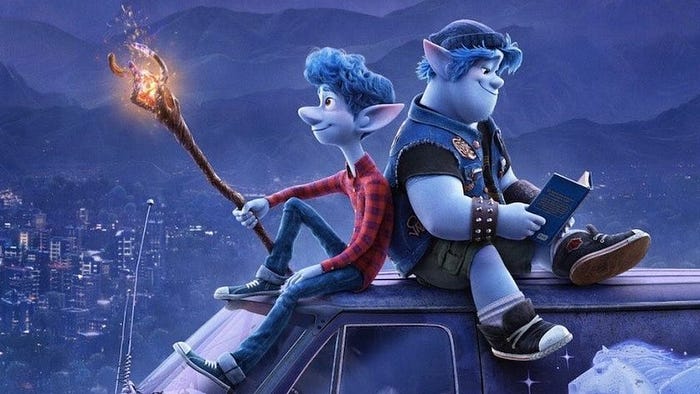
Onward is Disney-Pixar’s newest film and the start of a new era for the filmmaking giant. Where the past half-decade has been defined by forced sequels at the hand of the all-mighty dollar, the current slate of films reflects a step in the right direction. Focusing heavily on new properties and new voices, Pixar aims to reclaim the former glory they once attained before being commandeered and restrained by the House of Mouse.
That’s not to say that Pixar hasn’t released a good film in that timespan, Coco and Inside Out are both worthy of attention, but the general sentiment from the studio has been that of strained creativity. Despite pushing the technological boundaries at every turn, the substance of their sequels consistently left much to be desired. It’s clear that Disney’s demand for franchise properties left a significant impact on the quality of their work, and I (like many) feared how this would change the studio in the future.
It’s with strong appreciation that I must commend Pixar on their newest film. It’s not without flaws, certain parts of the film reflect the corporate mindset so prevalent in modern animation, but the general quality of the film was surprisingly above expectations. Onward might lack the visual flair and individuality that many of my favorite modern animated films may have (see Coco or Spider-Verse), but the strong writing and world-building with a neat juxtaposition between reality and fantasy make it one of the more bearable films in Pixar’s library.
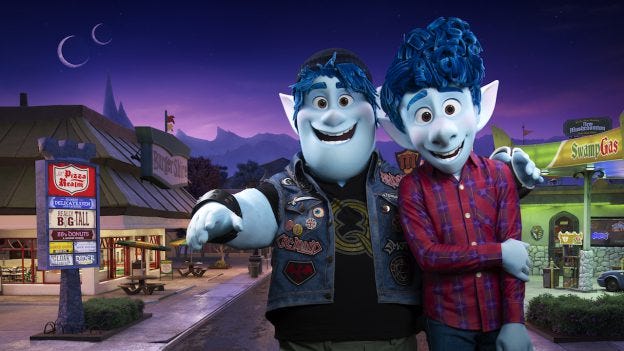
Taking a heavy focus on the ways individuality is shaped by loss and eventual growth, Onward follows two elvish teens, Ian and Barley, as they take on a dangerous journey to bring back their father for a day. Ian never met his dad but has always had the pressure of living up to his omniscient expectations riding on his every move. Barley knew his father very little, but in loss has blinded himself to fear and lacks strong moral guidance because of it. Their mother, Laurel, has moved on to another lover but recognizes the weight on her two sons. From the start, it’s incredibly clear that the main characters are not only affected by the loss of the father figure, but exhibit subtleties more complex than the average character in a children’s film of a similar plot.
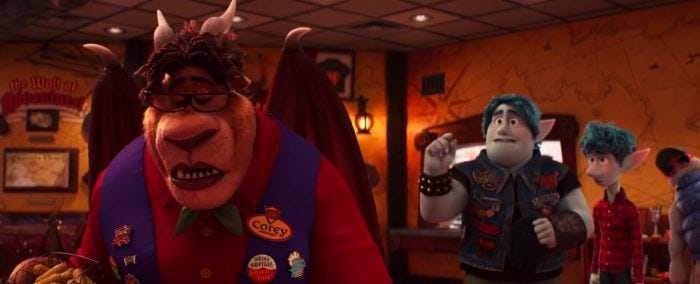
That might be the key to Pixar’s Onward. The animation style, aesthetic, plot direction, and acting may be far more predictable and shallow compared to some of the studio’s greatest successes, but the film’s writing separates it from the crowd by delivering a truly human experience in a world of monsters. Obviously the subject matter holds weight, but the way in which characters react to these hardships surprised me in their brutal reality. The mother can move on and experience love again after loss. Ian, the youngest, begins to recognize that he always had a strong figure in his life to direct him, even if societal expectations place that burden on the father. Barley is open about the pain death brought to him, and reflects on the ways it not only affects his emotional state but social dynamics as well. He lives in regret of childish fear, and that crucial aspect of his development has pushed him towards a lifestyle of pseudo-adventuring. If he can live up to this fantasized version of himself, then he isn’t the weak failure who turned his back on someone who loved him.
The decision to have the father character follow the leads around as a pair of pants might just seem like a sight gag at first glance, but develops a strong, looming presence over the plot. Could this be how we truly view death? The deceased are no longer here, but their presence can fill a room without direct communication. It’s rare to see a silent character in modern animation do anything but provide comedic relief, and despite the glaring inconsistencies in logic, the pants deliver some of the most emotional scenes in the film.
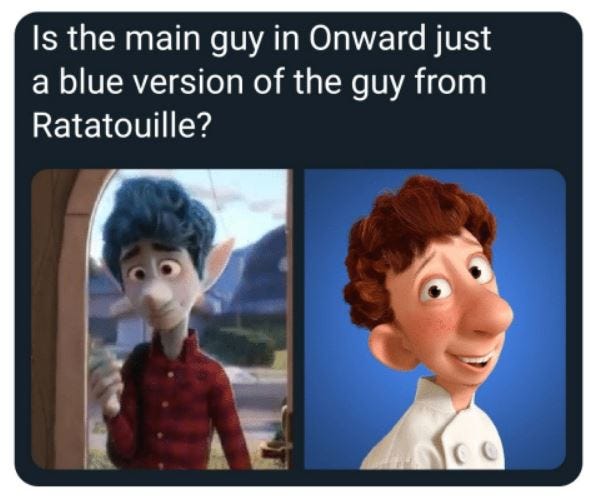
I do take issue however with the rather bland art style. I don’t feel any need to call out the “lanky guy with big nose and curly hair” motif of modern animation, but I did find myself chuckling as I walked past a “Spies in Disguise” poster on the way to the bathroom. In both films, Tom Holland’s characters look pretty identical, and that general sense of uninspired design can be said for most of the cast. With exception to Octavia Spencer’s Manticore, the character design leaves a very poor impression. Not only are characters restricted by this odd style, but the landscape as well. The opening of the film is bright, colorful, whimsical, and stylized. The rest of the film (for plot purposes) saturates the colors and brings our characters to a hybrid of archaic fantasy and suburban reality.
The decision to set a coming-of-age film in a mythical world is interesting, and the blending of fantasy quests for treasure and human problems (learning to drive, etc.) gives the film a unique flare, but I found the application to be quite dull. The film soars when it truly blends the stylistic motif and setting to create something special, and dips when it loses its identity. I absolutely loved seeing the school mascot turn into a villainous creature, but by the third encounter with the police, I found the film to be dragging on.
With some apprehension, I can recommend Onward as a simple but strong addition to Pixar’s growing library. The animation style and quality may be derivative of the lowest common denominator of films, but the intensely realistic writing and proudly unique character development reinforce the skills that brought Pixar to the top.
If this is the low bar for films without franchise potential, it’s clear that Pixar’s future is in good hands.
7/10
P.S: The Simpsons short at the beginning was really endearing. It shows that when directed with restraint and heart, The Simpsons can still be an incredibly strong vessel for storytelling. We can only hope this focus on character-based narrative without the need to regurgitate cinematic references somehow influences the television show for the rest of its unending, persistent, and grueling run.
Ryan Dorman is a Columnist and the Content Director for the Boardwalk Times. He can be found on Twitter at @OpentheDorman, and as a host of the Boardwalk Talk podcast on iTunes.