
I’d like to start this discussion by making it extremely clear that this is a subjective perspective. Unlike the logistical and corporate aspects of the quarantine, the consumer perception behind accepting risk in the face of limited mobility depends on the person in question. The article may be a case study on my own feelings, but I think it bears discussing to diversify the content presented to our audiences. It’s easy to give you explicit information on patterns of reopening, healthcare statistics, and prospective actions, but it’s much harder to classify and qualify the emotional response to a world more restrictive than anything we’re used to.
For those interested in the potential changes to the park, information on general responses to the virus, and updates that have come from Disney themselves, I implore you to check out Zach’s article on Disney Parks post-COVID -19. He did a brilliant job dissecting what we know so far, and it’s absolutely worth a read.
Earlier today I was having a conversation with my co-host of Boardwalk Talk, Ryan O’Reilly, as we usually do when the community begins a new argument or Disney announces something pertinent to the show. Call it keeping up on our jobs, or finding some catharsis in information unrelated to international collapse, but I find these discussions incredibly helpful in retaining my headspace. One day it might be a discussion about Twitter’s reaction to Rise of Skywalker, and the next could be a new Disney+ show that defies expectations and provides a solid reason to purchase the software.
Nonetheless, today’s conversation maneuvered in a different direction, but only momentarily. I had offhandedly mentioned a controversy that occurred before the pandemic, to which Ryan responded that he “couldn’t believe he went to Disneyland this year.” For a second I didn’t believe that he did, then I didn’t believe that I too had been to Galaxy’s Edge a couple of months ago (WDW). Not only has this situation affected my perception of time, but it has actively eroded my personality so much that the idea of leaving my home and entering a densely populated area is more nightmare than fantasy. I have become so accustomed to quarantine and the fear of spreading the virus to those most susceptible that my perception of the world has been redefined.
What were once fantasies of revisiting the Disney Parks have now been replaced with a dream of the open road and endless farmland. No longer do I crave a night at Epcot, but a solitary exploration of the wilderness under the stars. A meal at Steakhouse 55 may be nice, but my mental capacity has been shifted so far from the mass congregations of society that I almost find it more appetizing to eat at a small local establishment in the middle of nowhere. For a moment I believed this to be a reflection of the American Frontier; a mental response in the face of forced quarantine calling on my patriotic instinct to explore the unexplored, chart the uncharted, and live a life wholly unique to myself.
However, I find now that this goes far deeper than the necessity to be unrestrained. Maybe it isn’t the resurgence of this manifest destiny, rather, a re-awakening in the face of traumatic societal events that change what draws us out of the home. There’s nothing explicitly written in our genetic code that leads us to theme parks or concerts, so it could be assumed that some disruption in the status quo may influence our interests.
Much of what I’ve discussed is purely anecdotal, and an audience interested in resuming life as we once believed menial could disregard my fears as anxious and overly nervous, but I posit the question of what kind of world will exist a month, year, or a decade from today. To illustrate this, at least as an introduction to my issue, I’d like to re-enact a day at the Disney Parks with commentary on each event as they would pertain to life before and after the coronavirus. My fear is strong, but it is not unreasonable, and it may be more prevalent in the world’s populace than the economists and corporate shareholders would like to admit.
A Day at Disney
For the sake of the argument, we’re going to define a day at Disney that did once occur but is not a hyperbole or edge case that would misrepresent the average experience. An intelligent viewer could read my experience at Galaxy’s Edge and very easily understand how that wouldn’t fly during an international pandemic, but I believe that even an average, nonspecial day at the parks should elicit some fear in the minds of the reader.
We’re going to relive a day I spent at the Magic Kingdom with my father, sister, and a friend who hadn’t been to the park in many years. This group serves as a varied testing population ranging from incredible super-fan to unfamiliar guests that would likely be a stand-in for the average consumer at Walt Disney World.
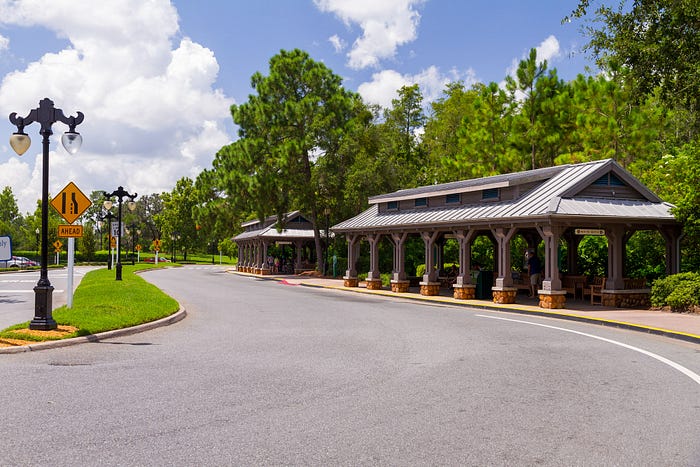
We begin our day at the Port Orleans: French Quarter. After leaving the room we walk to the bus stop where we reach our first issue. The current standards for bus pick up and drop off is to house guests in a small awning, waiting at a specified stop for a bus designed to handle a large capacity of people. In moments where the seats are full, the bus allows for standing room behind a yellow line, and when the capacity of the bus is full, people are pressed like sardines as they patiently wait to arrive at their destination. These moments of full capacity on busses are incredibly common at the start and end of the day but present a new fear in the face of an easily transmitted virus. A potential fix could be to schedule bus trips in advance, limiting the number of passengers on one bus at a time, but already we’re looking to redefine the entire transportation system at Walt Disney World.
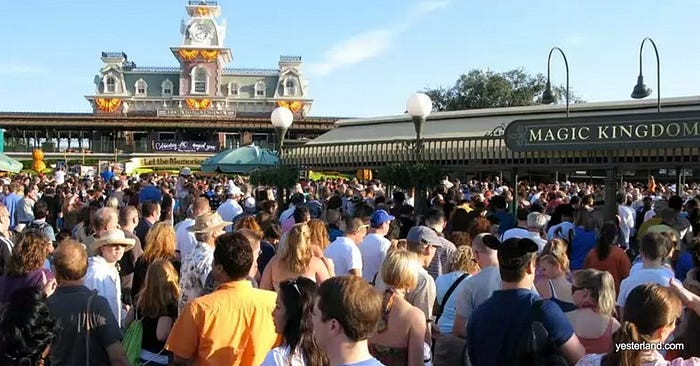
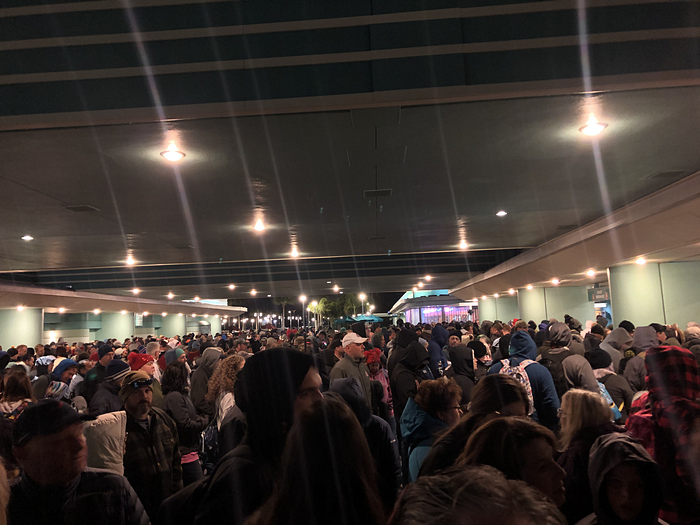
After leaving the hotel, and taking the crowded bus, we arrive at the Magic Kingdom. Walking into the park we’re faced with incredible crowds and the option of 10 lines for security and entry to the park. These lines are self-regulated, meaning that Disney currently has no control over how people congregate, and what is intended to be a line for MagicBand touchpoints amounts to little more than a structureless mass. In the future, the company will have to mandate lines with guests separated by six feet to prevent the spread of illness.
Already we have four moments (the bus stop, the bus, security, and MagicBand Touchpoints) where we come within six feet of what seemed like hundreds of other guests. We have only dissected the first few minutes of the day, and yet we have hundreds of instances where there’s a potential spread of disease. In addition, surfaces like bus seats, railings, touchpoints, gates, signs, benches, and metal detector bowls for phones have the potential to spread the virus. It would require a constant team cleaning each of these contact points every single time a guest uses one to keep them disinfected; an unrealistic possibility to say the least.
Let us focus on specific attractions for the rest of the summary, as other circumstances can be addressed separately. Over the day, our group had the opportunity to ride It’s A Small World, Big Thunder Mountain Railroad, Pirates of the Caribbean, The Haunted Mansion, Walt Disney’s Carousel of Progress, Snow White and the Seven Dwarves Mine Train, The Tomorrowland Transit Authority PeopleMover, Space Mountain, and Mickey’s Philharmagic. For sake of argument, we can divide these attractions into categories, those being the Dark Ride, Theater Show, and Roller Coaster.
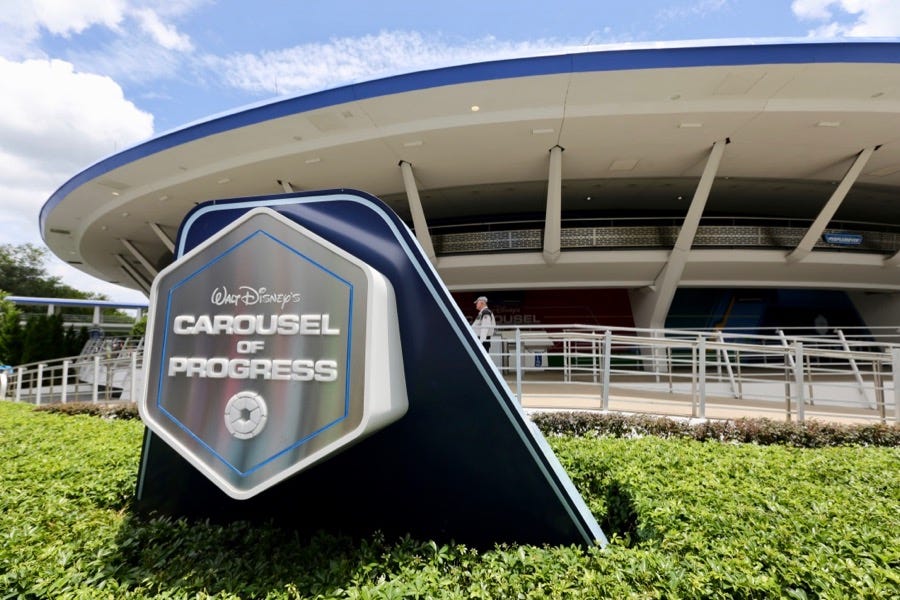
Theater attractions are the easiest to discuss in the wake of the virus, so I find it simple to start there. Over the day, we visited the Carousel of Progress and Mickey’s Philharmagic theaters, each presenting their own set of issues. For the Carousel, our first concern lies in the entrance, as guests enter a small walkway with handlebars as a small slope increases towards the theater. This would have to be routinely disinfected, as would the rest of the gates surrounding the platform of the theater. Within the theater itself, the seats would have to be disinfected after each show, but we reach another problem. It’s a constantly moving show, and there is no point where any one theater is empty. As guests leave the building, more guests enter, so that the show can continue on its rotating basis. Some have proposed running six groups, then none for a rotation, then another six, which may fix the viral issue but limits capacity, a running trend we will see throughout the analysis. Those familiar with the system should have no issue visualizing the predicament, where the constantly rotating theater for the show with only one entrance point limits opportunities for the cast to clean contaminated seats. In fact, there are zero opportunities. The daily capacity of this attraction is around 240 people per show, with 6 theaters and a 21-minute runtime bringing total capacity to 4200 an hour, or on average 50,000 a day. The attraction RARELY has a full theater, but let’s air on the side of caution.
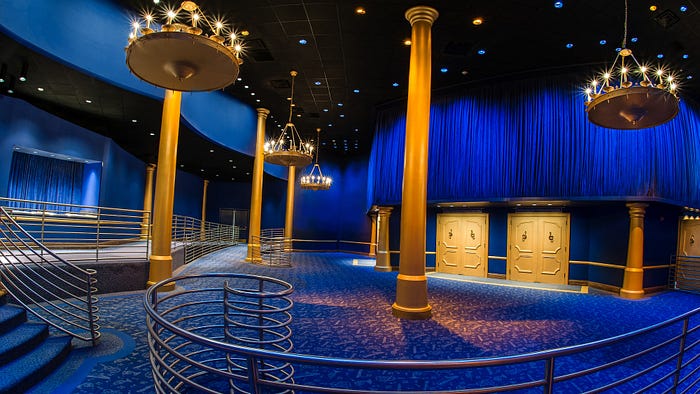
A similar problem arises in Mickey’s Philharmagic but to far greater risk. The first room of the queue has guests enter a snaking maze of guiding handrails and other methods of keeping viewers in line. These handrails would have to be disinfected routinely, which changes the entire dynamic of the wait system (technically there are also handrails outside, but I digress). Currently, guests can enter the room at their own discretion, but this would offer cast zero time to clean the handrails. It seems like it would instead have to work in the same manner as the Haunted Mansion, where groups are rotated into the attraction once the group ahead had left the current room in the queue and the cast had completed their disinfection procedure. Then, guests are funneled from this room to another, only this time the variables become more complicated. First, guests are asked to pick up their 3-D glasses, which are placed on their faces. It’s possible that these could be cleaned between shows with UV light, but let’s assume that a guest grabs multiple and then puts the stack back. Now we have a number of glasses that could carry the virus being placed near the mouth region, which is exactly what officials tell us to avoid. Then, to get to a lower area, guests are again given handrails which would have to follow the same cleaning requirements as the previous room. The biggest problem with this room arises when waiting for the theater doors to open, where guests are corralled into an open space and tightly pack together as they wait. Just like the security and MagicBand entry touchpoint lines from before, the proximity at which guests stand and the duration of which they’re forced to remain there feel incredibly troublesome in this situation. Six feet apart is not an option when capacity is the goal, so (I assume) capacity will have to be limited in future showings. The theater itself obviously will be a location where many, many guests make contact with a surface, but this should be handled similarly to the Carousel of Progress. The daily capacity of this attraction is around 19,000 people.
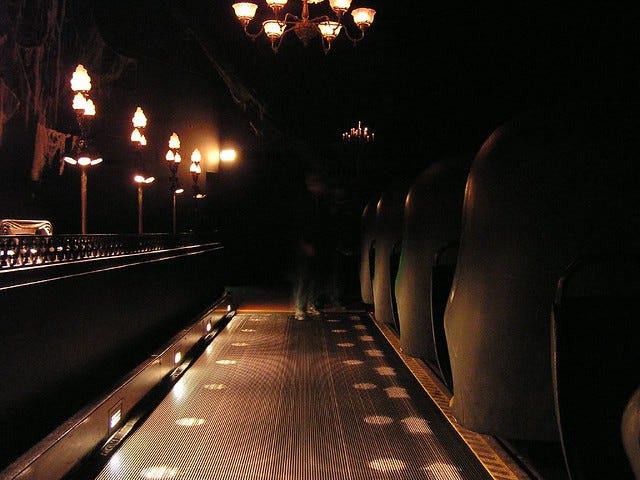
Moving on to Dark Rides, one of the consistent complaints about these ride systems is the manner in which load and unload works relative to the speed of the attraction. Dark rides succeed at one thing, that being the ability to take a large capacity of guests and have them enter and exit the attraction without changing the flow for those currently experiencing the show scenes. For the uninitiated, take a look at the ground as you enter your Doom Buggy on The Haunted Mansion. Notice that it continues to move, and you are asked to enter a moving vehicle. That is because everyone on the ride is moving at the same speed, and you are simply entering and exiting that loop as it moves throughout the show. It’s perfect for efficiency, but a nightmare when anything needs to stop. Remember all of the times your Doom Buggy slowed down in the Madame Leota room? How about when you were forced to listen to that awfully annoying tune in the graveyard for minutes on end as the ride came to a halt? That’s likely a result of a guest exiting or entering the attraction needing more time than allotted to safely perform their necessary action. It can be clearly seen that any action aside from swiftly entering and exiting has detrimental effects on the narrative quality.
When it comes to cleaning these vehicles, the question of how is both unanswered and incredibly complex. We can start by looking at The Haunted Mansion, which positions guests in a highly interactive queue before entering two rooms that force guests to huddle close together away from the walls. The interactive aspect requires a lot of touching, and that would need to be routinely disinfected. These moments in the parlor or the stretching room are important to the narrative (and required for safety in Disneyland), but the forced proximity ensures the transmitting of disease if a guest in the room should be an asymptomatic carrier. Following this room, guests are again clustered together as they wait to enter a Doom Buggy. This seems similar to the problems with theaters, but an incredible issue arises specifically to this ride system. We assumed the theater seats could be cleaned between shows, but how would one clean a Doom Buggy? It would seem that it needs a full cleaning on the handlebars, seats, and interior walls of the vehicle, but as we’ve noted there is very little time between approaching the vehicle and the last possible moment where you can enter. Even so, the cleaning job would be lazy if it needed to be fast enough to get a guest on the ride. Some proposals have hypothesized a potential UV cleaning room between unloading and the loading area, but this remains to be seen. If they can perform some cleaning magic in between these two spots there should be no detrimental effect on the ride itself, but in the event that they are limited in technology, I’d imagine that this would have a significant effect on the ride’s operation speed. The daily capacity of this attraction is about 40,000 people.
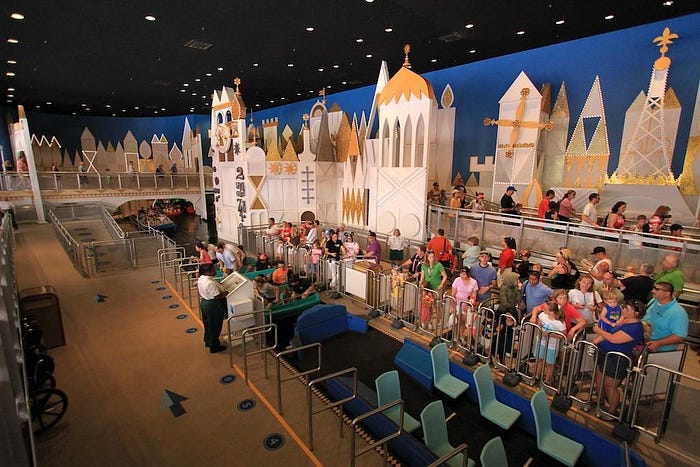
As boat rides, It’s A Small World, and Pirates of the Caribbean face nearly identical issues, those being in the touchable surfaces in the queue and the contact with the boat itself. However, as the load and unload are performed at the same dock, the opportunity for cleaning while maintaining a consistent flow on the attraction is extremely limited. These attractions see a daily capacity of 38,000 and 33,000 people respectively.
The Tomorrowland Transit Authority PeopleMover not only has guests in extremely close proximity within the queue while touching metal guard rails, but the ride vehicles leave absolutely zero time to clean the system in between the load and unload while also placing groups in close proximity. The attraction has an hour capacity of nearly 5,000 guests.
Finally, with similar ride systems, the coasters include Space Mountain, Big Thunder Mountain Railroad, and the Seven Dwarves Mine Train. The time spent in the queue is similar across the board, and guests make contact with all safety bars and ride vehicles. Space Mountain has a behind-the-scenes portion between the load and unload, but the other two immediately load guests onto ride vehicles after the other group has disembarked. Unlike Dark Rides, decreasing the hourly capacity of the attraction by cleaning the vehicles before loading on another group could curb this issue. Yet again we are faced with an incredibly limited park capacity in the face of safety. These attractions have a daily capacity of 25,000, 19,000, and 21,000 people respectively.
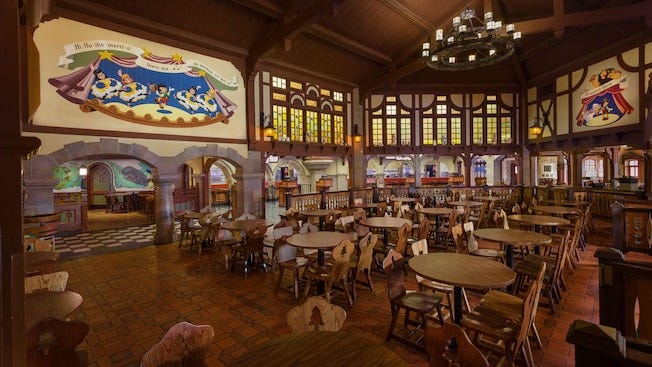
That day we had lunch at the Pinnochio Village Haus, a quick-service spot with incredibly dull food, but is frequented by a sizeable number of guests every day. Like most of the counter-service opportunities at the Magic Kingdom, seating is on a first-come-first-serve basis that rotates as guests leave following their meal. With no oversight by Disney staff, these dining establishments are developed to allow for a quick transition between parties to maximize hourly capacity and ensure customers have a chance to sit while they eat. However, if we begin to introduce a system to clean the tables (especially when the surfaces are being used for dining), a fundamental restructuring of the quick service model will be required.
Note that this summary only reflects the named attractions and establishments we visited on an average day and does not dissect the various other attractions at the park, as well as contact with other guests when walking, shopping, engaging in various other experiences within the park. Even with the limited information discussed, it becomes incredibly apparent that the current status quo in experiencing a Disney Park cannot sustain itself in a world both susceptible and fearful of an incredibly transmittable virus. The daily capacity at these attractions and numerous opportunities for viral transmitting can turn what was once a pleasant escape to a petri dish.
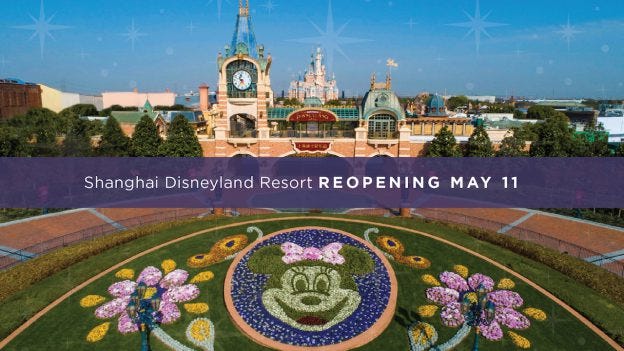
UPDATE 5/8/20: Shanghai Disneyland has released a video sharing guidelines to follow when the park re-opens. The park will see advanced ticket reservations, temperature screening tents, social distancing in the entrance and attractions (guests in every other row), plastic gloves when boarding attractions, face mask trash cans, limited table seating at quick-service restaurants, amongst other rules. These are a good start, but will not be enough at full capacity and given the push-back by American citizens may not be followed as rigorously here. Let’s see what happens.
https://www.youtube.com/watch?v=cLNzpPpYlUc
Now What?
We’ve established that the average day at one of the Disney Parks could be incredibly risky, especially for those who are immunocompromised or may see the strongest effects of the virus, but the Disney Company clearly has no plans to accept defeat. Their parks may be hotspots for transmission, and the number of people frequenting the parks (even at half or quarter capacity) is a nearly uncontrollable force of nature. If you give guests the opportunity to attend, they will, and there’s no guarantee that they’ll follow any guidelines given to them.
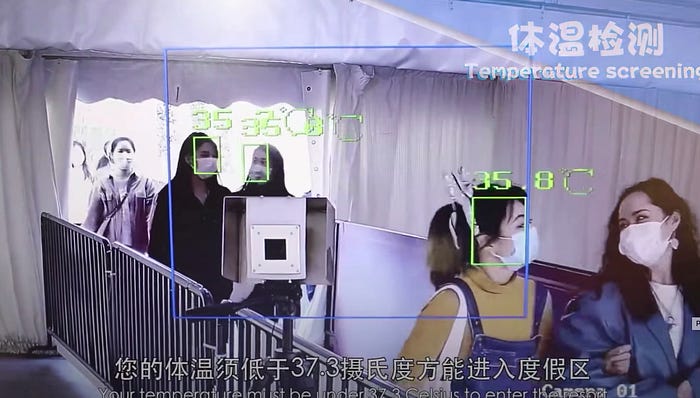
Some may propose a mask or glove policy for the parks, but without strong policing and a commitment to removing guests from the park when they fail to abide by these rules, these guidelines mean nothing. Bob Iger once mentioned a “temperature check” at the park entrance, but recent data signifying the potential for asymptomatic carriers turn this provision into a little more than security theater. If the selfish protests and mindless complaints show anything, it’s a vocal distaste for any form of preventative measures. Universally mandated rules forcing guests to wear masks and gloves would make the cleaning procedures mentioned previously much simpler (if not unnecessary), but without threatening park removal for breaking these rules, they’re more fantasy than reality.
Recently at the Quarter 2 Earnings Call, Disney announced that they’d be reopening Shanghai Disneyland at 30% capacity as the world eases restrictions on quarantine. With tight staffing and conscious control over what stays open and closed, the parks may make a small profit, but I’m beginning to question how many guests will want to return to congregating this soon. Thirty percent of Shanghai’s capacity is 24,000 people, a small number relative to max capacity, but large enough that I question how comfortable I’d be joining in. If experts note that we should be cautious even when going to purchase essentials at a grocery store, what would lead us to be comfortable in a crowd roughly the size of my hometown? Does my craving for themed experiences outweigh the potential of receiving a deadly and permanently damaging virus?
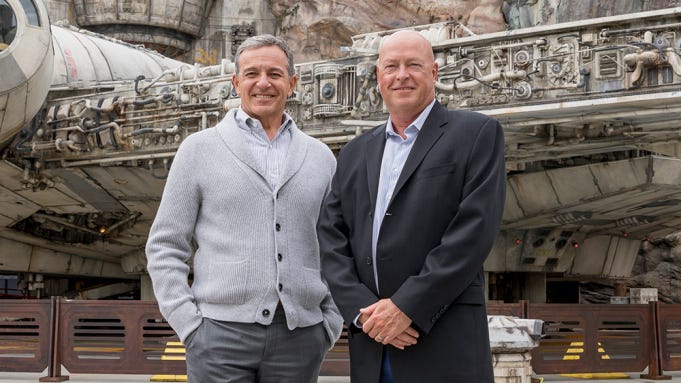
For a moment, I’d like to offer a bit of advice to Disney, a company reporting a profit hit of 90% during the virus ($1.4 Billion). Most of the money lost has come from the theme park/cruise/consumer products division, and I feel that Disney has a handle on their theatrical and television content at the moment, so I will only reflect on the parks. Speaking strictly in a business sense, and ignoring the ethical quandaries and biological discussion, Disney should be pivoting towards a limited capacity, limited hours, and limited property opening for at least the next year. None of the domestic parks should open to full capacity until late 2021 (when vaccination and treatment are normalized), while resorts with multiple parks should see a rotating schedule of opening to ensure the property sees a limited influx of guests at one given time. Walt Disney World has the capacity for a lot of people, but opening all four parks, hotels, and other experiences (Disney Springs, Water Parks, etc.) would amount to a negligent hotspot for both guests and cast. The reader of this article may have the choice of whether to attend the parks at the opening, but cast members dependent on the income faced with a lack of unemployment money are bound to their duties. This may be curbed by limiting park opening to half of those at a given resort per day, and starting a reservation system for all guests to ensure that the hotel rooms are only being sold to those with park reservations. Each hotel could also offer buildings on a rotating basis so that each room can be cleaned after a given stay.
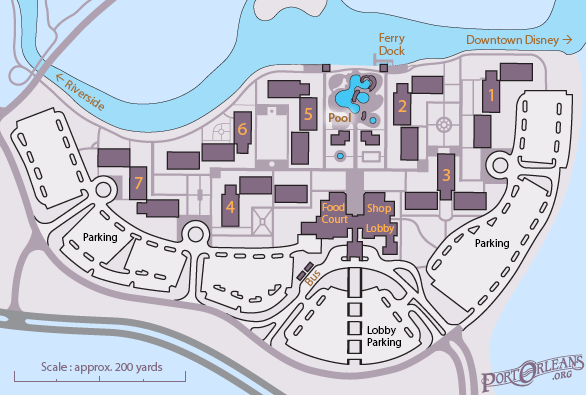
Hypothetically, let’s look at Port Orleans: French Quarter. The hotel has seven separate buildings that house guests, and one option would be to keep 3–4 open at one time. All guests would arrive on the same day, check-in on the same day, and stay in the buildings open during their respective time-slot. Each day of their 4-day trip allows them access to one of two parks, and everyone leaves the resort on the same day. The next week sees guests staying in the other 4–3 buildings unused the previous week, as cleaning crews are deployed to sanitize the living spaces previously used. Capacity at Walt Disney World would be limited, and the experience more restrictive than before, but would allow for a return to normality before our society properly adapts to living with the virus.
I must conclude the article though with my own feelings, those being an incredible distaste for anything centered around congregations any time soon. I recognize I need to attend school, work a job, and engage in small societal mainstays (groceries, mail, etc.) to keep the cogs turning in modern America, but anything aside from the necessary seems like a frivolous endeavor. I do take some risk going out to buy food, but without that action, I’d find myself slowly dying of malnutrition. The risk of transmitting the disease is far outweighed by the unavoidable problem of requiring sustenance. However, the risk of acquiring and spreading the virus by visiting a theme park does not outweigh those found living in a world without entertainment. There is no trade-off here, you can absolutely survive without theme parks to ensure fewer people die of a preventable disease. With an incredibly overwhelmed medical infrastructure and lacking governmental response to pleas for improved testing and medical equipment in the United States, it may be the harsh truth that our hobbies hold no bearing on ethical action under societal “collapse.”
Disney seems to want to open these parks as soon as possible to retain some of the social weight they’ve accumulated in the past couple of decades. Going to Disney is a monumental social event, and some sense of necessity surrounds the idea as consumers enjoy a fun escape from the menial aspects of life. With time, we may begin to recognize the non-importance of a day at Disneyland compared to another week with our grandparents, or how silly a craving for a corn dog is when the virus can take those we love without any warning. It’s understandable that the corporate aspects of Disney seek to lift their profits, but asking what position these actions put their cast in and how congregation before social and medical provisions are more strongly developed can affect the longevity of our healthcare system seems fair.
Looking strictly at Disney, we have an issue. Disneyland workers are desperate for income as some cannot feed their family, but forcing them to work within a mass of tens of thousands of people before the virus has been somewhat handled seems absolutely unfair. I see calls for the economy to reopen justified with either craving for something we once had many opportunities to capitalize on (going out to eat, the movies, etc.) or the fear of corporate America losing money and the tangible effects that may have on this economy. To be fair, though, these complaints come from those who are desperate to be consumers again, not from those who already couldn’t feed their family under the economic structure pre-COVID. “The economy has to reopen,” they say, without any plan on rectifying the issues present before while begging to introduce new, deadly variables to an already oppressive system. If not for your own health, or the health of your family, ask for continued quarantine to preserve the health of low-wage workers forced to do the bidding of the consumer and corporate once the economy begins to re-open.
These are the perspectives that run through my mind when analyzing how comfortable I’ll be when returning to the Disney Parks in the near future. I’ve illustrated the sheer number of people attending the park (even at limited capacity), the metaphorical hoops park guests will have to jump through to ensure personal safety, and the financial toil placed on the working class once unemployment benefits and rent freezing (dependent on location) are taken away as a viable alternative. It’s incredibly clear that if you get the virus, you start a whole new process of transmitting that may lead to more deaths. It may be someone you know, it may not be, but nonetheless it’s clear that unnecessary actions that could transmit the virus put a price on life far lower than the individual’s perceived value of frivolous experiences.
I must beg the audience to avoid Disney Parks until testing, treatment, and preventative measures are fully available to the public. I also beg the audience to, if possible, remain in quarantine until it is humanly impossible to leave. Unless you lack the materials to sustain yourself within your home, find your home compromised by the virus, or are being forced to return to work out of financial necessity, no amount of “liberation” or “freedom” is worth the pressure you put on an already volatile system. The Disney Parks are incredible pieces of art that I’m extremely glad I’ve had the pleasure to view, but preserving the quality of life for those close to me or forced to work during these times is far more important than anything a theme park could provide.
Even after all of this ends (we’re seeing more research on contracting it again), returning to mass congregating without the fear of viral infection will be an action of the past. Max capacity at the parks would see an incredible number of people in one space at one time (roughly 60,000 per park), and it’s a near guarantee that we’ll never fully escape the clutches of the virus. Will this moment of quarantine shift interest towards more isolated, constrained social outlets? I’m curious to see how National Park, Drive-In Theater, and small roadside business attendance changes in the wake of quarantined life. Will people be interested in returning to a social life defined by densely populated hotspots, or will there be a resurgence in experiences that demand a far smaller group to achieve the fullest potential? I suppose we will see in time.
I hope you and your family are staying safe, and I hope we can return to the activities we appreciate someday soon. What that maybe I’m not sure, but I would gladly give up what I enjoy today to ensure I can still see what I love tomorrow.
Ryan Dorman is a Columnist and the Content Director for the Boardwalk Times. He can be found on Twitter at @OpentheDorman, and as a host of the Boardwalk Talk podcast on iTunes.
Info On Daily Capacity: