
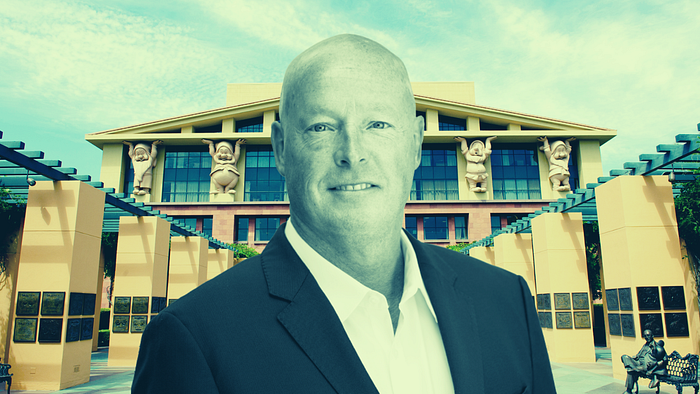
As someone who covered the tumultuous reign of former Disney CEO Bob Chapek in real time, Chapek’s new book Behind the Castle Walls was a captivating read. The book painted a clearer picture of who Chapek is and what went down during his time at Disney. Obviously, the book is one side of a complex story with more entries to come (Robbie Whelan’s House of Mouse and a potential second book from former Disney CEO Bob Iger could shift the narrative dramatically). Yet Behind the Castle Walls makes two things abundantly clear about Bob Chapek’s career at Disney.
- It never made any sense for him to be CEO of Disney.
- He never had a chance.
Behind the Castle Walls sheds light on Chapek’s early beginnings in Indiana and his career. A tidbit that wasn’t discussed enough after the book’s release was how Chapek truly ended up at Disney by accident, and seemingly it wasn’t his dream. He was let go from Heinz, and he went to Cincinnati for a job with U.S. Shoe Corporation. Chapek’s friend on the West Coast told him that there was a job at Disney. Chapek in his book goes on to say this about Disney, “I wish I could say that the idea and allure of working for the company I visited as a child on family trips registered with me in an especially poignant way, but that wouldn’t be altogether true. I was more focused on building a better life for my children than reliving my past.” Later in the book, Chapek tries to make it seem like the CEO of Disney is his dream job, but after reading how he started at Disney, it’s clear that Chapek just wanted to be CEO of something. His passion for Disney felt almost too casual in that section.
Chapek’s book dives into his entire career at Disney, but at times it feels like the book accelerates too quickly. There are plenty of moments that I wish were further expanded and discussed within the book. From his early years in home video, Chapek basically takes credit for creating the direct-to-DVD sequel. The chapter is even given the hilarious title of “Jafar Returns, and I Emerge.” During this chapter, Chapek also takes plenty of shots at John Lasseter, the former Chief Creative Officer of Pixar and Walt Disney Animation Studios. Yet Chapek never elaborates further, but if you read between the lines, it seems like there was some tension there.
Chapek also makes the claim that Dick Cook (Former Chairman of Walt Disney Studios) believes that he had something to do with his firing. Chapek also states he reached out to Cook multiple times but never heard back. Chapek also said he loved working for Cook. I was taken aback by this story because I never knew there was a potential Chapek angle when it came to Dick Cook’s firing from Disney. Now I wish someone would ask Dick Cook to see if we could get a straight answer after all this time. Within that same chapter, Chapek also presents himself as the guy who changed Disney’s windowing and theatrical release schedule.
Chapek also hints throughout the book that he had the idea of Disney+ going all the way back to Disney’s deal with Apple’s iTunes. Chapek felt that Disney should solely control its release and distribution model, and they shouldn’t put that decision in the hands of another party. Chapek even had his team study the iTunes model, and it was the first “baby steps” towards Disney+. Another example of foreshadowing comes when Chapek takes over Disney Consumer Products; he forces the Disney Publishing team to relocate from New York to Glendale. The move overall caused groans, but a majority of the workforce made the move. Chapek would attempt the same blunt relocation strategy with Walt Disney Imagineering and other Disney Experiences divisions years later, but with the move being from Glendale, California, to Lake Nona, Florida. The move would never happen for most.
Despite succeeding Tom Staggs as Disney Parks Chairman, Chapek barely mentions Staggs in his book, except on a few occasions. We don’t really get a feel for how Chapek felt about his predecessor. Chapek recounts a moment when Bob Iger asks him if Tom Staggs or Jay Rasulo should be his successor, and Chapek boldly answered “neither” as he thought it should be him. Yet Chapek doesn’t dive into his relationships with Staggs or Rasulo. Even Iger asking Chapek for his advice on his then-successor just didn’t make sense. The business relationship of Iger and Chapek just never made sense while reading the book. Chapek had a tremendous sense for business, but he didn’t understand the more complex sides of Disney. Iger had to have known that.
Yet Iger kept promoting Chapek. When Chapek became Disney Parks Chairman, he began to raise prices but specifically targeted the annual passholder demographic. Disney’s most loyal demographic but arguably loses the most money on (this is debatable depending on the passholders and their spending, etc.). Chapek even says, “local Disney Adults didn’t drive the economics of the park with their annual pass.” Chapek seems to embrace this role as the disruptor of the Disney Parks and bringing them into a new era of revenue. Chapek, when he became CEO, continued to raise prices and make changes at the parks, including adding the loathed reservation system. Chapek even laments that he was “tarred and feathered” for the move and that then-Disney Experiences Chairman Josh D’Amaro escaped the criticism.
Even though he was frustrated with D’Amaro not getting a share of the blame in the unpopular decisions he was making, Chapek does take credit for the rise of Josh D’Amaro. Chapek makes it seem like D’Amaro was a nobody within Disney that he keeps promoting. Yet it does seem like if there is one thing that both Chapek and Iger agree on, it’s that Josh D’Amaro is the right guy to lead Disney. Chapek doesn’t take any shots at D’Amaro besides seemingly being frustrated that D’Amaro never received criticism for unpopular changes at the Disney Parks. Chapek, in a later part of his book, also mentions that, besides Kareem Daniel, one of the only other people he trusts is Josh D’Amaro.
Chapek later in his book also claims he never really “played the game” to become CEO of Disney. Chapek said that while his colleagues were positioning themselves to be heir apparents, he was just focused on his role. However, a part of me truly wonders, after Chapek’s comments about Dick Cook and his lack of comments regarding Tom Staggs, Jay Rasulo, Kevin Mayer, Catherine Powell, Peter Rice, etc., if Chapek was truly playing the game. Chapek briefly mentions that Tom Staggs was referred to as a “favorite son” at Disney. Chapek goes on about how Staggs saved Bob Iger’s life. Chapek ended up taking over the Shanghai Disneyland project from Staggs after he got sick. Yet we don’t really get any personal details on Chapek’s relationship with Staggs, which seems odd. Chapek, however, does take Staggs side when it came to Iger’s comments about a COO not being considered an heir apparent. Chapek also kept his comments on former Disney executive Kevin Mayer brief. Chapek said that Mayer was “never a serious candidate” for CEO despite promoting himself as the potential next CEO of Disney. Chapek also revealed he wanted the Disney CEO job all the way back in 2017 and that the day Iger told him they were buying 21st Century Fox, he actually thought Iger was telling him he was going to be his successor. I just don’t buy that Chapek didn’t “play the game.” It’s also clear Chapek definitely has more thoughts on Staggs, Mayer, and others. Maybe Chapek just wanted to avoid further controversy?
Chapek throughout his book takes shots at Bob Iger. He does speak warmly of some of their interactions, but throughout the book, Chapek isn’t afraid to hint at Iger’s darker side. Chapek goes as far as to say Iger thought of himself as “the modern reincarnation of Walt Disney.” This, of course, is balanced with Chapek telling stories of him and Iger laughing and playing “Name That Tune” on private flights to Shanghai.
The final chapters of Chapek’s book are thrilling as we get to see certain events that were reported about from his point of view. Yet there are some pivotal quotes within these final chapters that seem to be largely ignored or glossed over by the media. The biggest to me is when Disney Chairman of the Board Susan Arnold tells Chapek, “Well, it’s going to happen, and it’s going to happen fast. Bob has decided relatively abruptly that he’s done, and that the job is yours.” The quote reveals two key factors. Chapek’s move to CEO has to be rushed, and Iger is abruptly done. Arnold then shared another concerning statement to Chapek: “We need this to happen immediately. Don’t negotiate; just say yes.”
Why was the Disney Board in such a rush?
Chapek doesn’t go into that, but it does add a lot of mystery and intrigue to Chapek’s succession. Chapek does mention that he wanted to establish relationships with other Disney divisions and key stakeholders before becoming CEO. Susan Arnold told him that he didn’t have time, and this was before the pandemic even happened. Chapek wanted to make an effort, and Disney’s Board didn’t even allow him to have a shot.
Chapek, once he got the job, immediately knew something was wrong. Iger is icy, and the pandemic is clearly coming. Chapek also recalls the infamous Annual Shareholders Meeting flight where Iger springs the Q&A portion on him, and Chapek, who wasn’t allowed to meet and learn about the other Disney divisions, now has to answer questions about them. During the flight back from the meeting, Disney CFO Christine McCarthy wanted her first one-on-one meeting with Chapek to be done on the flight, and Iger got offended at the mere possibility. The pandemic basically arrived by the time the Annual Shareholders Meeting occurred. Chapek does mention in his book that various high-ranking officials and executives believe Iger knew about the pandemic and that’s why he abruptly stepped down as CEO. Chapek also, as he stated throughout the book, believed that Iger felt he could get his job back at any point (Chapek was right in the end on that).
Chapek goes into the various communications mishaps of his CEO tenure, including the Scarlett Johansson/Black Widow debacle and Don’t Say Gay. Chapek does state that Iger approved the scathing statement during the Black Widow debacle. Chapek does mention how he felt like Zenia Mucha, former Disney communications chief, didn’t have his back and was an Iger loyalist. Chapek’s various interactions with Susan Arnold seem to set him up for failure at every turn. However, it was hard to believe that Chapek left out Geoff Morrell and Kristina Schake from his story. Chapek’s two communication chief hires don’t get mentioned in his book? Morrell has a three-month stint and made $10 million, and there is zero mention of it? Kristina Schake is hired, and she’s immediately seen dining with Bob Iger by Bob Chapek, and that doesn’t make it into this book? I am just baffled Chapek left some compelling angles on the cutting room floor.
Chapek also doesn’t go into his interactions with other board members or explain why the board suddenly turned on him after giving him an extension. Chapek doesn’t even bring up the reported facts that his team of Kristina Schake, Christine McCarthy, Horacio Gutierrez, Dana Walden, Alan Bergman, and Josh D’Amaro all told the Board they lost confidence in him. That remains a befuddling mystery that seems like the answers will be in another book.
Chapek is fired randomly on a Sunday as he’s about to head to an Elton John concert that Disney+ was livestreaming (Chapek claims that he was the one to fix Disney’s relationship with Elton John). Susan Arnold doesn’t give Chapek a chance to make a statement or anything. After that, Chapek’s sign on Castaway Cay, Disney Cruise Line’s private island, is removed. Chapek’s Star Wars: Galactic Starcruiser also closes a few months later. Chapek defends the Galactic Starcruiser, saying everyone knows that hotels aren’t profitable within the first year. Chapek acknowledges that Disney erases his contributions to the company.
Chapek’s rise to the top of Disney never made sense.
He got his start at Disney out of necessity to provide for his family and to move back to the West Coast. Chapek did oversee major consumer shifts in Home Video and at Walt Disney Studios. Chapek did reorganize Disney Consumer Products. Chapek did make major changes to the Disney Parks and basically grew the division into its current Disney Experiences juggernaut form.
Chapek understood business. Chapek was a disruptor, as he calls himself in his book. However, it’s clear from the very start of his Disney career that he had rocky relationships with creatives, cast members, leaders, and even Bob Iger. Both the Disney Board and Bob Iger had to have known Chapek’s work style and personality. Chapek may have checked all the boxes on paper to be a strictly business CEO, but that doesn’t change the fact that Disney is uniquely situated and needs a more dynamic CEO who can balance business and creatives.
Once Chapek got to the top, he never stood a chance. The odds were simply never in his favor.
Support Boardwalk Times
Be sure to follow Boardwalk Times for more coverage of The Walt Disney Company.
Zach Perilstein is the Editor-in-Chief of the Boardwalk Times