
Universal has never been a company shy about its appetite for implementing intellectual properties into its theme parks, with its unabashed, borderline holistic reliance on media franchises as the basis of new lands and attractions historically setting it apart from its foremost competitor in the themed entertainment industry. It’s a natural and, frankly, expected route for a company rooted in media to take upon a substantial foray into the theme park space: produce films that guests want to tangibly experience, construct for them the opportunity to do so, and profit.
This modus operandi has been employed by Universal throughout much of its history as a significant player in the proverbial theme park game, with some of Universal Studios Florida’s earliest marketing efforts promising guests the opportunity to “ride the movies.” Every single one of the park’s meaningful offerings had some form of IP tie-in upon its June 7, 1990 opening, and though this wasn’t a statement true of Universal Islands of Adventure (the company’s second Orlando gate) at the time of its May 1999 launch, Universal has again installed a more IP-dependent strategy in recent years, particularly after the tide-turning success brought by the 2010 opening of The Wizarding World of Harry Potter — Hogsmeade. Of the 40 company-defined “attractions” currently available for guests to experience throughout Universal Studios Florida and Universal Islands of Adventure, all but one are representative of an external film, television, or book franchise, with the lone outlier — Hollywood Rip Ride Rockit at Universal Studios Florida — set to close in September of this year.
This isn’t to say that Universal is resting on its laurels or exploiting its legacy with regard to IP implementation, as it’s not as though the company is slapping the name of a popular franchise on a lackluster attraction as a means to manufacture interest (generally speaking). One could even argue that Universal has been a more significant contributor to the advancement of theme park technology than The Walt Disney Company in recent years, with attractions like Harry Potter and the Forbidden Journey, Hagrid’s Magical Creatures Motorbike, and Jurassic World VelociCoaster redefining the standard at a domestic theme park while simultaneously leveraging a cherished brand to generate initial curiosity.
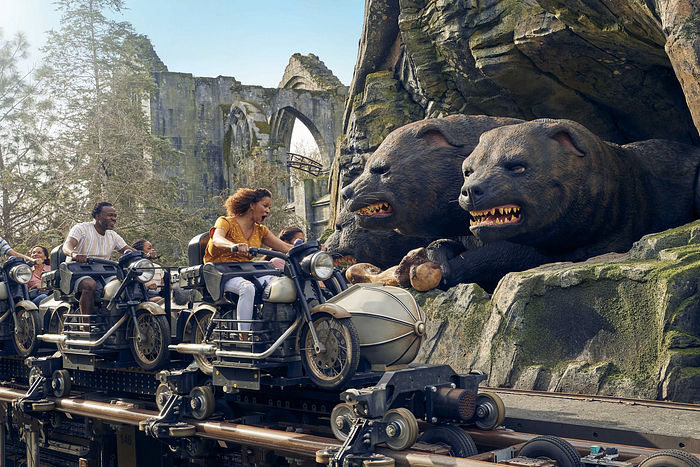
This idea of Universal pairing a known property with a technologically innovative attraction or land will perhaps be most prominently on display later this year when guests begin to walk beneath the Chronos at Epic Universe, the Universal Orlando Resort’s third traditional gate that’s set to open on May 22, 2025. Described by the company as its “most technologically advanced park” yet, Epic Universe will boast 11 inventive attractions, the bulk of these themed to a beloved IP. These offerings will be spread across five distinct lands, or “worlds,” four of which follow the standard Universal Parks convention of being centered around a historically successful media franchise (with the Celestial Park entry area being the sole land not entirely based on a pre-existing brand).
SUPER NINTENDO WORLD, the ultimate realization of an East Coast Mario-themed experience that was first promised nearly a decade ago, projects as a categorical success given the lasting cultural relevance of the Mario character and the reputation of the lands currently available at the company’s Osaka and Hollywood parks. How to Train Your Dragon — Isle of Berk, too, looks promising given the popularity of the How to Train Your Dragon film series, which itself is set to receive renewed interest this summer with a live-action adaptation from Universal. Given the quality of The Wizarding World of Harry Potter — Hogsmeade at Universal Islands of Adventure and The Wizarding World of Harry Potter — Diagon Alley at Universal Studios Florida, one can assume that The Wizarding World of Harry Potter — Ministry of Magic will be a themed entertainment triumph, with Universal Creative Executive Producer Scott Verble even describing its flagship E-ticket as “the most ambitious ride we’ve ever created” and “an absolute game-changer.”
It’s the park’s fourth immersive world, however, that’s (perhaps anecdotally) most fervently captured the imaginations of the theme park faithful, that’s ushered in a cascading wave of anticipation and enthusiasm on the back of its singularity. Dark Universe, a land celebrating the seminal Universal Monsters franchise of old, is an offering wholly unique to the Universal Orlando Resort given not only its tonal individuality, but its originality; though based on a century-old property integral to the fabric of Universal as a studio, Dark Universe is perhaps the most original land Universal Creative has crafted in over 25 years, the group using the area as an opportunity to tell a fresh story with culturally iconic characters as opposed to simply re-creating the setting of an individual IP.
And it’s this original land-wide narrative that will make Dark Universe singular not only in the context of the larger park, but as a property for Universal as a company; historically reactionary when it comes to constructing themed areas based on beloved franchises, Dark Universe is perhaps as proactive as Universal has ever been with regard to grand-scale implementation of a particular IP at its parks, the company viewing the land as an opportunity to “make the next generation fall in love with the Monsters.” Universal, as a film studio, has spent much of the 21st century attempting to carve out a more significant place in the zeitgeist for the once-prized Monsters property, often to no avail; should Dark Universe realize its teeming potential as a quasi-original offering, Universal will perhaps be provided a new blueprint for handling this foundational IP in other forms of media, installing a form of cyclical synergy perfected by its preeminent competitor that it hasn’t yet had the opportunity to itself enact.
“To a new world of Gods and monsters.”
These words, uttered by the sinister Dr. Pretorius in 1935’s Bride of Frankenstein, have become emblematic of the Universal Monsters franchise, a series of quintessential horror films released between 1931 and 1956 that are to Universal what films like Snow White and the Seven Dwarfs, Fantasia, and Cinderella are to Disney. The franchise, in addition to playing an integral role in Universal’s early-century ascent to sustained prominence, introduced to popular culture not only a group of characters notable to the point of assumed cursory knowledge but their definitive portrayals; Dracula, Frankenstein, the Bride of Frankenstein, the Wolf Man, the Creature from the Black Lagoon — these horror icons trace their on-screen roots back to Universal, serving as some of the company’s earliest — and most enduring — contributions to contemporary culture.
The Monsters brand, given its intrinsic value to Universal as an entity, has long had some level of representation at the company’s parks, ranging from a quick-service café at Universal Studios Florida to a near-permanent presence, in some form, at the annual Halloween Horror Nights event. Dark Universe, however, will be the property’s most considerable manifestation yet, a meticulously crafted oasis for lovers of the cinematic macabre that will advance not only the technology available and utilized in the themed entertainment space but the way in which Universal Creative tells its stories.
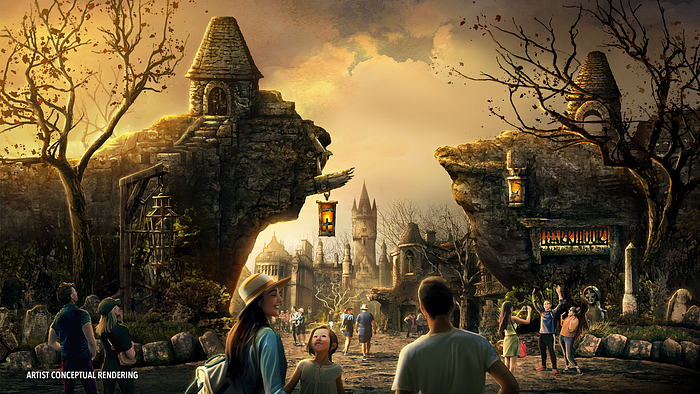
Whereas the company’s other IP-themed areas (both at Epic Universe and its additional parks) broadly employ the convention of transporting guests to physical representations of settings they’ve seen in external media, Dark Universe will take parkgoers to an entirely new location not pre-established in a film or television series. Rather than constructing a scaled depiction of Transylvania, the Bavarian Alps, or the Black Lagoon to serve as the setting of Dark Universe, Universal Creative conceived of Darkmoor, a wholly original village that, while aesthetically inspired by the Gothic architecture that permeates Dracula and Frankenstein, is a new creation that weaves together the stories of the company’s iconic Monsters and houses them under one proverbial roof.
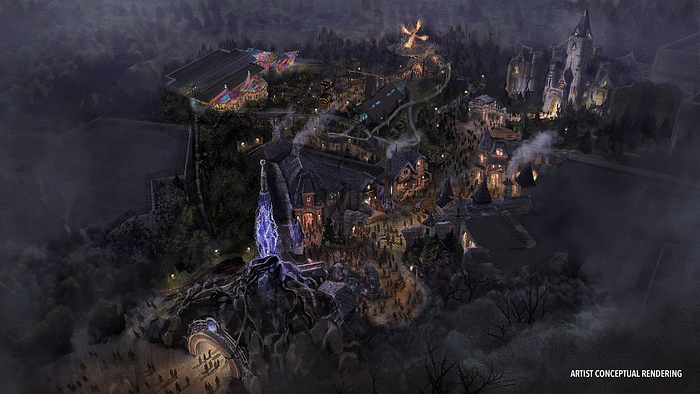
This is a shrewd, if not necessary, creative decision, as a singular communal setting seems an obvious requisite for a cohesive theme park land involving characters that canonically inhabit all reaches of the globe; that said, the development of an entirely fictional setting (despite the presence of existing characters) serves as a departure for Universal from its typical M.O. Guests traversing the shadowy streets of Darkmoor are not merely existing in a facsimile of a setting they’ve seen in a movie, à la Hogsmeade, Diagon Alley, Jurassic Park, the list goes on; they’re instead engaging with a setting and resulting story tailored exclusively for the park, this inherently serving as an ambitious creative endeavor for a company that’s long garnered praise for its near-exact replications of locations pre-existing in other forms of media (namely the Harry Potter series).
Available for guests to experience at Dark Universe will be two marquee attractions, two restaurants (one of which will feature dining “monster hunters” with which guests can interact), character meet-and-greets, a “monster makeup experience,” shopping, and various other offerings. As opposed to an area like New York at Universal Studios Florida or Marvel Super Hero Island at Universal Islands of Adventure (which, while enjoyable, do not attempt to convey a throughline message), Dark Universe looks set to present a cohesive narrative, an all-encompassing story rich in original lore that’s available to uncover for those willing to engage with it critically.
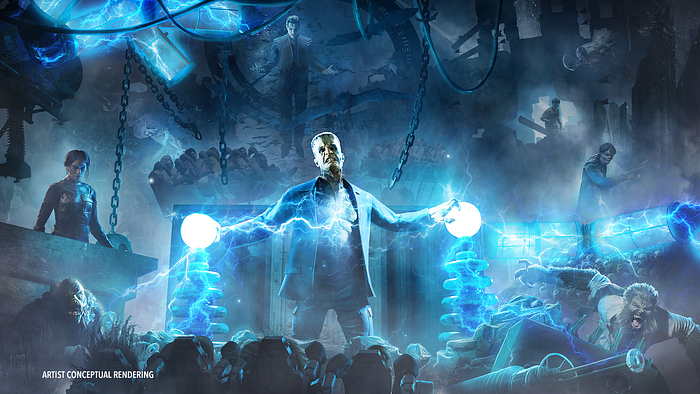
All of Dark Universe’s auxiliary offerings exist to supplement the story of Monsters Unchained: The Frankenstein Experiment, the land’s tentpole E-ticket that will give Universal an increase in something it conspicuously lacks: prominent (and year-round) characters native to its theme parks. An innovative motion simulator that will feature a bevy of iconic characters and more than 10 jaw-dropping animated figures, Monsters Unchained: The Frankenstein Experiment will bring guests into the manor of Dr. Victoria Frankenstein, a morally ambiguous scientist who is holding the Universal Monsters in her estate as a population for her various experiments. Though narratively the great, great-granddaughter of Henry Frankenstein (who appears in both 1931’s Frankenstein and 1935’s Bride of Frankenstein), Victoria is an otherwise original character who is not only present on the ride, but the reason for its inciting incident.
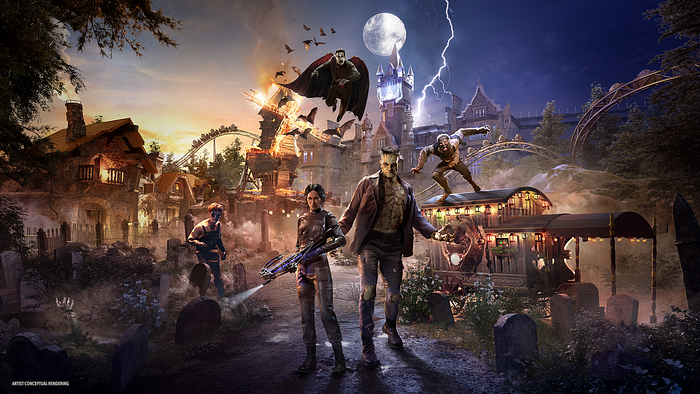
Whereas Disney (at least historically) is not afraid to present IP-devoid narratives and create parks-specific characters to headline its attractions, Universal has traditionally shied away from telling large-scale original stories at its parks, this a byproduct of the company’s previously explored franchise-reliant strategy. Dark Universe— and, more specifically, the existence of Darkmoor and Dr. Victoria Frankenstein — signals an at least initial departure from this approach, potentially suggesting that more original storytelling may be in store for Universal Creative in the future.
Dark Universe projects as an offering unparalleled throughout the rest of the Universal Orlando Resort for an extensive list of reasons, its deliberate horror-centric tone, “cutting edge” attraction technology, and restaurant that serves steaks on stakes being paramount among them; that said, it’s the land’s existence as a largely original entity that tells its own story as opposed to replicating another that makes it truly unique compared to Universal’s other IP-themed areas, and if it’s received as the company hopes, it could establish for Universal a new path forward with regard to mainstream utilization of the Monsters property.
Dark Universe is a risk.
It’s a calculated one, sure, but even the most optimistic enthusiast would concede that investing hundreds of millions, if not billions, of dollars into a land based on a rather niche property that has struggled to maintain recent cultural relevance is an inherently risky proposition. Though the Monsters today still inhabit a corner of the zeitgeist, their prominence is almost entirely a product of Universal’s early-to-mid 20th-century productions, as the company has not yet discovered a consistently advantageous formula for the contemporary application of the IP.
This isn’t for lack of trying, as the studio, to its credit, has consistently produced Monsters-adjacent content over the past quarter-century in an attempt to make fresh renditions of these characters resonate with new audiences. It caught lightning in a bottle with 1999’s The Mummy, an Indiana Jones-inspired action/adventure take on the 1932 Monsters classic of the same name; the Brendan Fraser and Rachel Weisz vehicle was a hit with audiences, grossing over $400 million at the worldwide box office before sparking what would become a fruitful franchise for the company. The perhaps unexpected audience acclaim prompted Universal to apply the film’s blueprint to its Monsters brand more directly, tasking director Stephen Sommers with helming a blockbuster monster mash in the form of 2004’s Van Helsing.
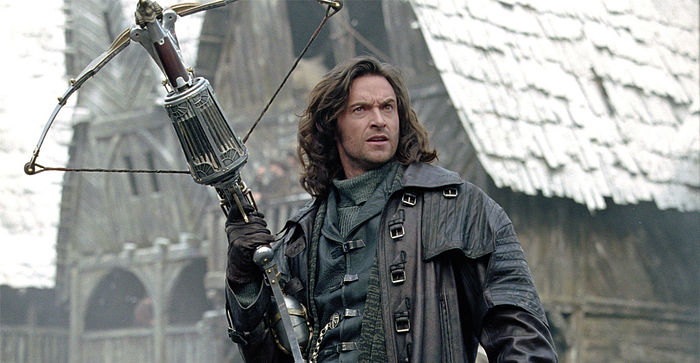
Led by seemingly viable action stars in Hugh Jackman (X-Men) and Kate Beckinsale (Underworld), Van Helsing was Universal’s attempt to transform the Monsters IP into summer popcorn fare, transposing the spirited vibe of The Mummy atop a brooding Gothic setting that saw the coalescence of cherished characters like Dracula and Frankenstein’s monster. The result was a tonally inconsistent, paint-by-numbers action flick panned by critics and audiences alike, the film failing to turn a profit during its initial box office run while serving as the punchline of jokes from movie critics across the country.
The film’s recent emergence as a cult classic aside, Van Helsing’s initial failure prompted Universal to shelve its long-term plans for the foiled franchise (which included a sequel and attraction at the Universal Orlando Resort), sending the company back to the drawing board regarding its approach to the Monsters IP. It released the third film in The Mummy franchise in 2008 before returning to the brand’s horror roots in the form of 2010’s The Wolfman, a mega-budget remake of the 1941 Universal classic now considered a pillar of the werewolf subgenre; it, too, was a critical and commercial flop, failing to recoup its money at the box office as it amassed a 32% approval rating on Rotten Tomatoes (to its credit, its audience score is a bit higher… at 33%).
Struggling to concoct a sustainable strategy for this structural IP, Universal thought it saw a path forward in the form of the ‘cinematic universe,’ an, at the time, novel Hollywood trend that had come in vogue thanks to Marvel Studios and its successful ‘Marvel Cinematic Universe.’ The storytelling technique was developed to provide an umbrella, of sorts, over seemingly isolated films that boasted their own distinct characters, settings, and tones; though these movies were entirely disparate, they transpired within one communal world, opening the door for eventual crossover in the form of summer blockbusters. Marvel ushered in the latest wave of the craze with 2008’s Iron Man, establishing a cinematic universe inhabited by a significant number of cherished Marvel Comics characters; the initial films in the franchise proved successful with audiences, with 2012’s The Avengers — the culmination of the series’ first ‘phase’ that featured heroes like Iron Man, Captain America, The Hulk, and Thor, among others — grossing over $1.5 billion at the worldwide box office.
Universal was not alone in its desire to transpose the Marvel formula onto one of its own properties, ultimately circling the Monsters as its brand most ripe for the cinematic universe treatment. This wasn’t a fundamentally misguided step, as it’s not as though occupying a singular world was a concept foreign to the IP; 1943’s Frankenstein Meets the Wolf Man, 1944’s House of Frankenstein, and 1945’s House of Dracula featured significant character crossover, cementing the original run of Monster movies as one of Hollywood’s earliest examples of the ‘cinematic universe’ fad. Where Universal erred with its contemporary effort was with regard to tone, as instead of crafting horror-centric films in the vein of its original productions, it churned out gaudy action flicks that attempted to replicate Marvel’s model sans the heart and charm.
Dracula Untold, released just a few weeks before Halloween in 2014, was the company’s first attempt at launching a communal universe, and though it performed moderately well at the box office, poor critical and audience reception prompted Universal to omit the film from its future franchise plans. It gave the effort another go in 2017 with the release of The Mummy, marketing the Tom Cruise vehicle as the start of its impractically ambitious ‘Dark Universe’ franchise; with Johnny Depp and Javier Bardem already signed on for future installments and performers like Angelina Jolie and Dwayne Johnson rumored to have interest, Universal viewed the series as its next mega-franchise, a summer cash cow that it hoped to milk for at least the next decade.
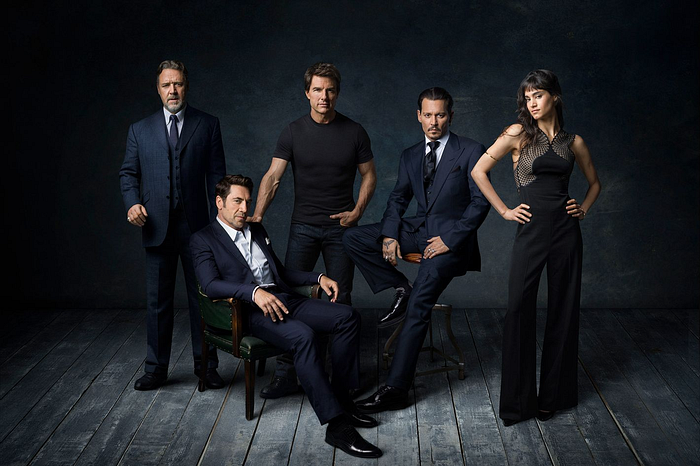
The Mummy was a cinematic disaster, draining money at the seams as it received nothing but ridicule from both critics and general audiences. The mass rejection caused Universal to abandon its plans for the shared universe entirely, leaving a notorious cast photo featuring Cruise, Depp, Bardem, Russell Crowe, and Sofia Boutella as one of the lone remnants of one of the bigger Hollywood blunders of the century.
The studio adopted a more auteur-driven approach to the Monsters IP in the wake of its monumental misstep, allowing creatives with unique horror-centric visions to craft narratively singular pictures within its proverbial sandbox. Films produced as part of this initiative include 2020’s The Invisible Man, 2023’s Renfield and The Last Voyage of the Demeter, and 2024’s Abigail, with the recently released Wolf Man being Universal’s latest Monsters-adjacent effort.
And while some of these films have garnered critical praise (most notably The Invisible Man and Abigail), they’re, at best, tangential iterations of the Monsters property, the vast majority of them sharing little in common with the horror classics on which they’re purportedly based. They’re, by and large, lower-budgeted productions that don’t need to rake in hundreds of millions of dollars to turn a profit, leading one to believe that Universal is likely content with its current Monsters strategy; that said, the company’s case-by-case, superficial usage of its seminal IP comes off as meandering, as though it’s not fully realizing the brand’s inherent potential. Sure, some of the studio’s recent Monsters-based releases have been enjoyable, but its insistence on producing unconventional, subversive takes on such cherished properties is actively hindering it from bringing these classic characters back into the limelight in a way it’s demonstrably eager to do.
This is what makes the forthcoming Dark Universe land at Epic Universe such an auspicious opportunity for Universal as a larger entity, as it’s set to simultaneously introduce more traditional portrayals of the Monsters to younger (and wider) audiences while potentially giving the company a layout for how to handle the IP in other forms of media. After spending much of the century attempting — and failing — to make fresh iterations of the Monsters resonate with modern audiences, conventional (if not updated) takes on the imperative characters are set to be constantly accessible to millions of parkgoers each year, something that, in theory, should increase the brand’s general relevance.
And it’s at Dark Universe that Universal can gauge which of its particular characters or stories of old speak to contemporary audiences, something that can help guide its approach to the brand in film and television. Perhaps the company notices excessively long wait times for the Bride of Frankenstein meet-and-greet or a strong reaction to the Gill-man animatronic, indicating there exists a demand to see these particular characters in additional media.
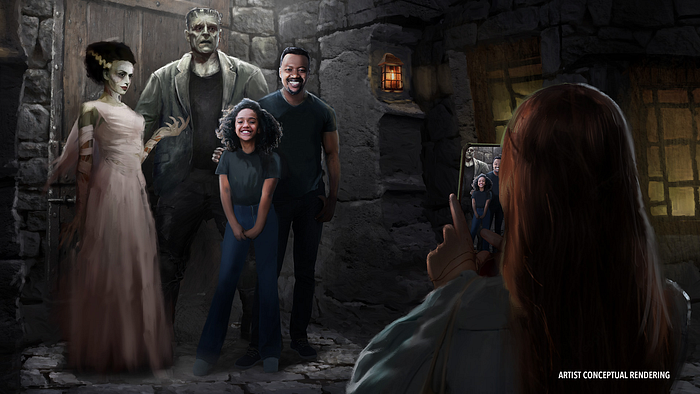
The idea of Dark Universe being a largely original creation boasting its own unique narrative is also to the company’s benefit here, as perhaps guests grow enamored with Darkmoor’s general feel, its walkaround monster hunters and musicians, or the story of Dr. Victoria Frankenstein; audiences taking to these original elements would open the door for adaptations in other forms of media, a manifestation of corporate synergy oft-employed by Disney (through film adaptations of original attractions like Pirates of the Caribbean, Haunted Mansion, and Jungle Cruise) that Universal has not yet had the opportunity to implement given its traditional reliance on IPs at its parks.
Darkmoor, should guests take to its rich lore and foreboding feel, seems a natural setting for a film or television series, with the village and the dubious aspirations of the Dr. Victoria Frankenstein character serving as a believable conceit for content that combines all of the company’s iconic Monsters. Given her prevalence in early marketing and merchandise, it looks as though Universal has immense confidence in and grand ambitions for Victoria Frankenstein, perhaps indicating that it views the character as one with crossover potential.
After decades of misfires that left the Monsters brand fading from public consciousness, there will soon exist a tangible breeding ground where Universal can not only create new swaths of fans but also gather direct, experiential information on which characters and tones audiences want to see across the company’s other arms, which is something it’s demonstrably had difficulty measuring in the recent past. The originality of the setting and presiding narrative also presents Universal with the opportunity to create external media adaptations that are simultaneously fresh and rooted in one of its foundational IPs, a theoretically advantageous avenue that few of its other park offerings have ever opened.
Universal’s bread-and-butter in the themed entertainment industry has historically been its ability to transport guests to near-identical re-creations of settings found in beloved media (with endlessly enjoyable attractions to boot), but Dark Universe is unique in that it’s the company’s most significant foray into original storytelling in some time; it includes characters intrinsic to its legacy, sure, but the creativity and ingenuity on display suggest not only a bold new era for Universal Creative, but a more cyclical and cohesive future for the Monsters IP. Universal has been stuck circling a fruitless roundabout with regard to the vital brand for much of the recent past, and should it fulfill its promise, Dark Universe could provide a way out.
Be sure to continue to follow Boardwalk Times for more coverage of Univeral Destinations & Experiences.
Support Boardwalk Times on Ko-Fi.
Support Boardwalk Times by shopping on Boardwalk Store:
If you like this article. Subscribe to my free newsletter Boardwalk Times: Stories from the Seashore, a monthly dose of Disney, its businesses, and the wider themed entertainment industry.
Kyle Silagyi is a columnist for the Boardwalk Times