
Walt Disney spoke about the “blessing of size” when introducing plans for what would evolve into the Walt Disney World Resort in a 1966 documentary film, stating in the ultimately unaired showcase of ideas that the 43 square mile plot of central Florida swampland could “hold all the ideas and plans we could possibly imagine.”
And though Disney’s Animal Kingdom is today the foremost beneficiary of this blessing (its 580-acre footprint exceeding the combined acreage total of the resort’s other three theme parks), it has little to show for its vastness in the way of attractions; Walt Disney World’s fourth gate today has only seven true rides spread out across its domain, a number comparatively minute to the totals boasted by Magic Kingdom, EPCOT, and Disney’s Hollywood Studios despite its significant size advantage.
This isn’t to say that Animal Kingdom is light on experiences; in fact, its lack of attractions is an unintentional consequence of the very elements that differentiate it from the resort’s other parks. The gate prioritizes landscape over architecture, providing ample space for guests to simply walk around and immerse themselves in a quasi-natural environment as opposed to checking off E-ticket after E-ticket as they work through the park. It makes for a distinct experience unparalleled throughout the rest of Walt Disney World; you can ride a version of a roller coaster or dark ride at any park, but there’s only one place where you can get stopped by a living, breathing giraffe in the middle of the road.
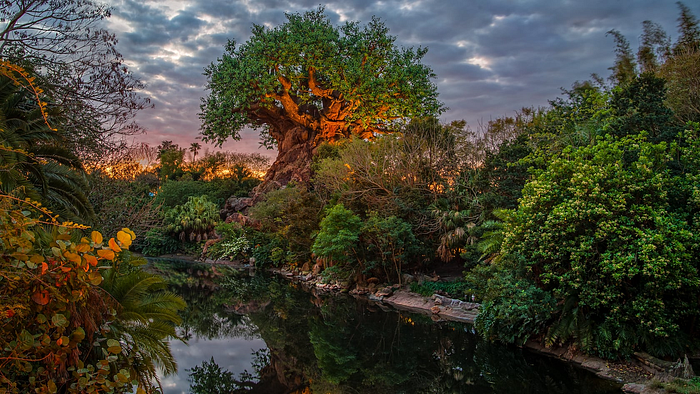
Animal Kingdom is a truly special offering unique amongst not only Disney, but general theme parks thanks to its dedication to and expression of its themes, and though it has its ardent supporters who understand and wax lyrical about its value, its comparative lack of offerings is simply a hurdle that some parkgoers cannot overcome. Walt Disney World vacations are significant expenditures, with the majority of guests looking to recoup their investments in the form of discernible experiences; understanding that a large swath of parkgoers attempt to do as much as possible in their limited time at the resort, a park predicated on the idea of taking a step back and truly immersing yourself in the setting is at an inherent disadvantage. This notion is routinely reflected in attendance numbers, as Animal Kingdom has been the Walt Disney World Resort’s least-visited park each year since 2021.
Disney understands that its youngest Florida gate is in need of additional, or at least new, offerings, with Animal Kingdom appearing to be a park of interest for the company at this time. A not-insubstantial chunk of the $60 billion Disney plans to invest into its Experiences division over the next decade looks to be earmarked for Animal Kingdom, with the imminent overhaul of DinoLand U.S.A. into a Tropical Americas-themed area being the most prominent announced alteration.
First presented as a ‘Blue Sky’ concept during Destination D23 in 2023, Disney confirmed its intentions to re-theme DinoLand U.S.A., which opened alongside the park in April of 1998, into a land that aims to evoke the stories and natural beauty of Central and South America at D23: The Ultimate Disney Fan Event in August of 2024. The reworked area, which will be Animal Kingdom’s first large-scale addition or modification since the opening of Pandora — The World of Avatar in 2017, will be anchored by attractions based on the Indiana Jones and Encanto intellectual properties, with auxiliary offerings including an IP-centric carousel and “one of the largest quick-service restaurants at Walt Disney World Resort.”

As is the case with effectively every contemporary Disney Parks announcement, the company’s plan was met with pushback, with many taking issue with its intention to re-work an opening day Animal Kingdom land into an area so shamelessly subservient to IPs. A contingent of enthusiasts also questioned the new land’s alignment with the core ideas so ingrained in the park’s identity, with some noting that the Indiana Jones and Encanto properties, on the surface, share little in common with Animal Kingdom thematically.
Is this actually the case? Is the forthcoming Tropical Americas section of Animal Kingdom a brazen and fundamentally misguided attempt to infuse recognized brands into a park that could use an attendance boost, or is there thematic merit to the concept? Does the removal of an original land signal the end of the park as a cohesive narrative, or does the new offering genuinely adhere to the themes integral to the story Animal Kingdom is attempting to tell?
Though it’s too early to arrive at a definitive answer (that destination won’t be reached until the land opens in 2027), the early signs are — perhaps shockingly — promising.
It would be logical for one to deduce that Joe Rohde, a recently anointed Disney Legend who served as the lead designer of Disney’s Animal Kingdom, was the person who initially conceived of the idea of a fourth Walt Disney World gate celebrating nature and wildlife, but the concept was actually the brainchild of then-CEO Michael Eisner, who felt the company could leverage the affection that people held for both animals and The Walt Disney Company in the form of a new park.
That was the extent of the idea, however. “We have the Magic Kingdom,” the executive was quoted as saying in the 1998 The Making of Disney’s Animal Kingdom Theme Park book penned by Melody Malmberg, “We should have Disney’s Animal Kingdom.” People like Disney, and people like animals; an animal-based theme park was a no-brainer, right?
A 400-page feasibility study orchestrated by the company concluded otherwise, but that didn’t stop it from further exploring the idea, with Rohde ultimately tasked with spearheading the effort. Armed with a mega document laying out pitfalls he and his team should avoid, Rohde led a group of Imagineers around the globe to gather experiential inspiration and develop connections with experts in the wildlife field, a multi-year process that concluded with the park’s approval in 1995.
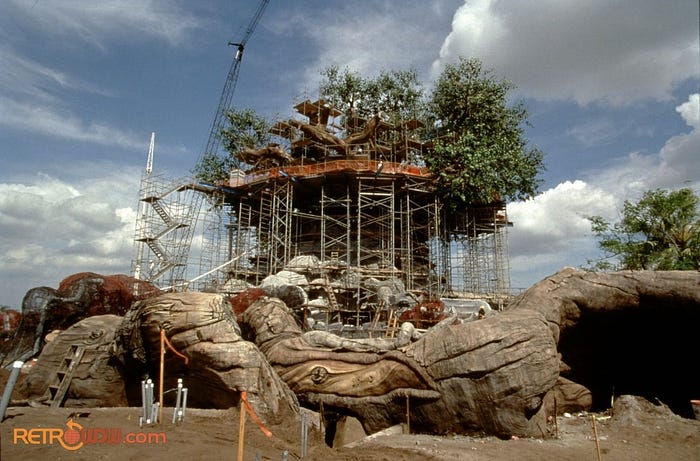
Disney’s Animal Kingdom went through several stages of design, with concepts continually evolving as construction progressed; that said, the story that Rohde and his team wanted to tell — and the themes at its core — emerged early. Rohde stated during a 2014 address to cast members that “the design of Animal Kingdom is very deliberately and very consciously built around a certain set of ideas, and once you start looking at Animal Kingdom with these ideas in mind, it becomes very clear that it is based on these ideas.”
There are countless motifs layered throughout the park for those willing to engage with it critically, the most obvious being the idea of a universal love of and fascination with animals. This is a rather overt theme expected of any zoo or theme park that prominently features animals, but it manifests uniquely at Animal Kingdom through the sheer number of animals — whether living, fictional, or extinct — that guests can interact with, the majority of them in quasi-natural settings.
“One way or another, whether it’s a live animal, an imaginary animal, a prehistoric animal, a storybook animal, one way or another, there’s a form of the animal world that brings people emotionally alive and that we can use to bring them into contact with this idea.” — Joe Rohde during a 2008 address to Animal Kingdom cast members
The park’s other pertinent themes (of which there are several) are not quite as conspicuous as the overarching ‘universal love of animals’ motif, but they’re integral to telling the park’s story and conveying its core message, which is ultimately one about conservation. Rohde has oft-spoken about the intrinsic value of nature as one of Animal Kingdom’s foundational concepts, this idea “that no other value can be held up against nature and trump it.” This is perhaps the park’s principal theme and is essential to its narrative, with it fundamentally shaping the way in which it was designed.
Animal Kingdom is a park that broadly prioritizes landscape over architecture, this deliberate design choice manifesting in the form of animal habitats, region-accurate flora, and vast areas to which meticulous care was afforded to evoke a sense of naturalness. The architecture in some areas of the park looks intentionally dilapidated — as though it’s “succumbing” to nature — as to not only add to the immersion, but to illustrate nature as a supreme, unrivaled entity that cannot be curtailed.
“That’s the reason why when a tree falls over in Animal Kingdom, we might just let it lie there and turn back into soil. That’s why the park has this sort of unrehearsed quality, why the buildings look like they’re crumbling and succumbing to the forces of nature, because we want that sense of power and primacy of nature to infuse the entire park.” — Joe Rohde during a 2014 address to cast members
A sub-theme inherent to this motif is one that Rohde describes as “the conflict between monetary, material value and the intrinsic value of nature,” weighing “the relative value of natural systems, commercial or material value versus spiritual value.” This is a conflict central to the narratives of several attractions throughout the park; the original Kilimanjaro Safaris story saw guests save a baby elephant from poachers, Kali River Rapids addresses deforestation, Expedition Everest sends parkgoers on a trek to a forbidden mountain as part of an expedition organized by the entrepreneurial Himalayan Escapes company, etc. Rohde admits that these narratives present a “biased” perspective on the conflict (one where the side representative of ‘spiritual value’ oft-prevails), but the stories clearly position nature as a supreme constitution, thus emphasizing its intrinsic value.
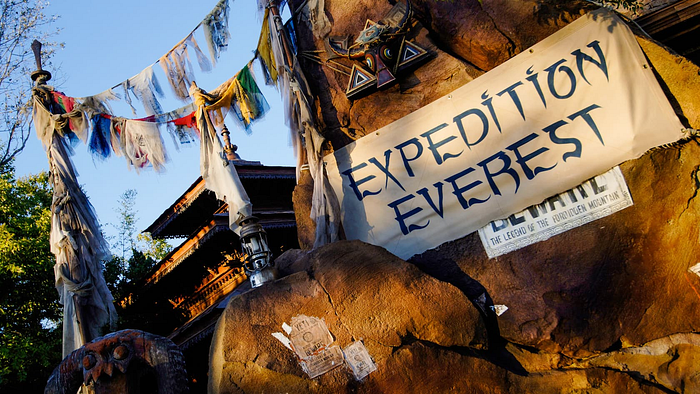
Personal transformation through adventure, or the idea that a person is fundamentally changed after experiencing something for the first time, is another of the park’s pillar themes, this notion is displayed through what Rohde describes as “unreconciled” architecture and attractions (namely the Kilimanjaro Safaris) that change not only over time but from minute-to-minute. Though thrill rides certainly provide a form of adventure, Animal Kingdom instead focuses on the concept as a “psychological phenomen[on] . . . the idea of going somewhere, doing something, seeing something you’ve never seen before, that this makes you new again.”
As is the case with all of the park’s themes, the transformation through adventure motif cohesively aligns with the idea of the intrinsic value of nature to help convey the park’s core conservation message, with the attraction stories crafted to adhere to the value of nature theme providing a form of psychological adventure for parkgoers. And though Animal Kingdom is ultimately a park that touts the imperative value of wildlife and nature, as a whole, you — and your role — within that story are just as important, with a personal call to action being the final of the gate’s vital themes.
You are at the center of most of the attractions and experiences available at Animal Kingdom. You are embarking on a trip up the forbidden mountain, you are flying through the air on the back of a banshee, you are encountering lions, okapis, and wildebeest in the flesh on an East African safari; the stories are about you, your experiences, and how you’ll respond when potentially forced to choose between commercial and spiritual value. Rohde effectively summarized the park’s themes and their cohesive, interwoven nature during a 2014 address to cast members, stating “We believe that if you put these [themes] together, you come to a place that is built about the supreme value of nature in which you undergo a transformation because you’ve set forth on adventure, when you receive a call to action, you will act on behalf of nature, since it is a supreme value.”
And each addition or alteration made to Animal Kingdom since its 1998 opening has, in some way, adhered to these themes; the Asia area, which opened in 1999 as the park’s first expansion, features architecture consistent with that throughout the park in terms of succumbing to nature, with both of the land’s attractions (Kali River Rapids and Expedition Everest) featuring narratives that highlight the commercial versus spiritual value motif. Pandora — The World of Avatar, though an outside-of-the-box expansion choice for a park predicated on nature given that it doesn’t exist in the physical world, is ultimately a flawless fit in Animal Kingdom given the themes beneath the plots of the Avatar films, with Rohde stating in 2014 that the 2009 blockbuster featured “an extraordinarily smooth and very clear and vivid expression of the underlying value systems of the park.”
Rohde ultimately retired from Walt Disney Imagineering in 2021, meaning the Tropical Americas-themed overhaul of DinoLand U.S.A. will be the first significant modification made to Animal Kingdom without his direct oversight. The lack of involvement from the individual who spearheaded the park’s development and played a pivotal role in shaping it into what it is today combined with the, at best, questionable thematic fits of Indiana Jones and Encanto have, again, left some hesitant about the quality of a Tropical Americas land, and the concerns are not wholly unfounded; that said, early signs indicate that the Disney of today not only has a surprisingly clear understanding of what Animal Kingdom’s core themes are, but it looks as though it’s actually attempting to adhere to these motifs as it develops this new area.
Though intended to emulate the architecture and geography of various physical areas across the globe, Animal Kingdom’s themed lands historically transport guests to fictional towns or villages representative of a broader region; the Africa section of the park, for example, takes guests to the East African port city of Harambe, while the Asia section places you at the base of the Himalayas in the village of Serka Zong (which itself is located in the Kingdom of Anandapur). This convention is even employed in Pandora — The World of Avatar, as guests visit the Valley of Mo’ara, a region of Pandora where humans and Na’vi peacefully co-exist.
Disney is set to fall back on this in-park institution with the construction of Tropical Americas, as the land will transport parkgoers to the fictional Latin American village of Pueblo Esperanza. Described by the Disney Parks Blog as a “lived in” area “with a long, rich history,” Pueblo Esperanza looks set to feature fastidiously-designed architecture aesthetically akin to that found in Central and South America.
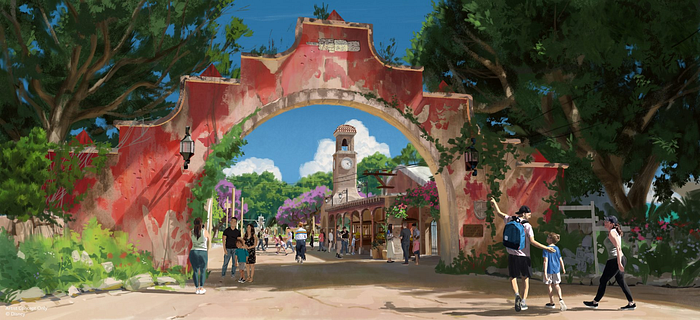
It’s important to note that the breadth of our current knowledge about the land is limited to a few pieces of concept art, which itself is always subject to change; that said, the early renderings look as though Imagineering has devoted significant effort to crafting an architecturally immersive land potentially as captivating and engaging as Harambe and Anandapur (according to Disney, Imagineers “conducted numerous research trips” to gather inspiration from several Latin American regions). Several pieces of concept art also showcase architecture succumbing to nature, with foliage enveloping the entry archway and a tree growing out of the dilapidated Maya temple that will house the Indiana Jones attraction.
The initial pitch for Pueblo Esperanza is encouraging; not only is Imagineering re-visiting the well-established and generally adored convention of constructing a fictional town emblematic of the key cultural and geographic components of a larger area of the world, but it looks to be staying true to the idea of architecture being subordinate to nature, a demonstrably effective means through which to present the intrinsic value of nature visually. Given that Pueblo Esperanza looks to be a village rooted in tradition as opposed to the beneficiary of significant external investment, one could easily envision the commercial value versus spiritual value motif being explored throughout the fictional town in some form, as well.
The Indiana Jones experience, a re-skin of the long-existing DINOSAUR attraction, looks set to borrow several pages from Expedition Everest’s playbook with regard to thematic cohesion and general narrative; an all-new story not necessarily connected to those found on the Indy attractions at Disneyland, Disneyland Paris, or Tokyo DisneySea, the new Animal Kingdom offering, per the Disney Parks Blog, will allow guests to join the iconic adventurer as he treks through a Maya temple only to encounter “a mythical creature deep within” the structure.
The attraction intends to adhere to the universal love of and fascination with animals theme by including a mythical animal in its climax, à la the Yeti in Expedition Everest. Early indications also suggest that the ride will employ a remixed version of Everest’s broad narrative— you and Indy are somewhere you’re not supposed to be, and nature, i.e. a mythological beast, admonishes you for your actions. This conveys a message similar to Everest regarding the value of psychological adventure, and though there’s no definitive information about the attraction’s subtext, it seems a natural setting for the conflict between material and spiritual value to be entertained.
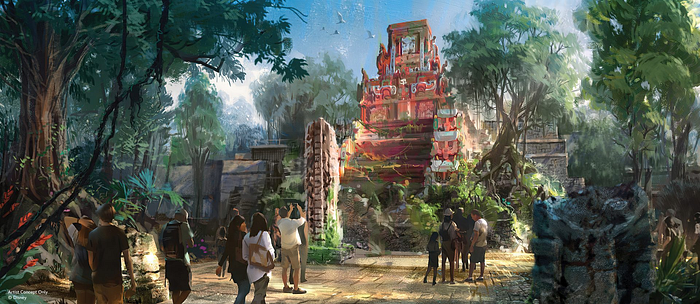
The ride taking place in a recently discovered Maya temple is not as effective a visual representation of the intrinsic value of nature motif as Kilimanjaro Safaris, Kali River Rapids, Expedition Everest, or even Avatar Flight of Passage, as those attractions are set in fabrications of (at least theoretically) natural settings; a Maya temple, though a visually striking structure, is ultimately a man-made piece of architecture, thus conveying little about the value of nature. That said, the temple (in early concept art) appears to be succumbing to nature, allowing it to check this proverbial thematic box; it also bears mentioning that the structure that houses the current DINOSAUR attraction is narratively man-made and does not look to be giving way to nature, perhaps indicating that this proposed Indy experience has the potential to be a more effective visual representation of the park’s preeminent theme than the ride it’s replacing.
Where this imminent Indiana Jones attraction falters thematically is with regard to a personal call to action, as though you’re going through the abandoned temple, you’re joined by a character whose films have generated over one billion dollars at the global box office. It looks as though guests are part of the story as opposed to at the center of it, making it thematically and narratively obtrusive compared to Animal Kingdom’s other attractions. Rohde spoke in 2014 about how the park’s offerings deliberately do not follow “some beloved or non-beloved third person and what happened to them,” a convention the forthcoming Indy ride looks set to buck; it’s possible that the ultimate narrative will better address this theme, but hesitancy is warranted.
One could argue that the Encanto attraction, which is an entirely new construction, is the principal reason why the Tropical Americas concept exists, as Disney has long been looking for ways to incorporate its 2021 smash hit into its parks. When the film’s iconic Casita showed up in the proposed land’s concept art at Destination D23 in 2023, many assumed that the ultimate attraction would be a trackless dark ride or Omnimover exploring the various spirited rooms of Casa Madrigal, prompting some to note that Encanto’s core themes, those about the value of family and self-acceptance, do not necessarily overlap with the motifs of Animal Kingdom.
Imagineering has seemingly addressed those concerns by instead making the attraction one centered around Antonio Madrigal, whose ‘gift’ in the film allows him to communicate with animals; the ride will allow guests to explore and immerse themselves in the tropical rainforest that his room has transformed into, encountering various animals and members of the Madrigal family along the way. This is quite an obvious manifestation of the universal love of animals theme, as parkgoers will interact with (at least fictional versions) of various animal species throughout the attraction; a counter-argument could be made that this park-wide motif is predicated on the presence of real animals, but if we’re counting the Yeti and Ikrans as representations of this theme, we can’t move the goalposts for an animated capybara.
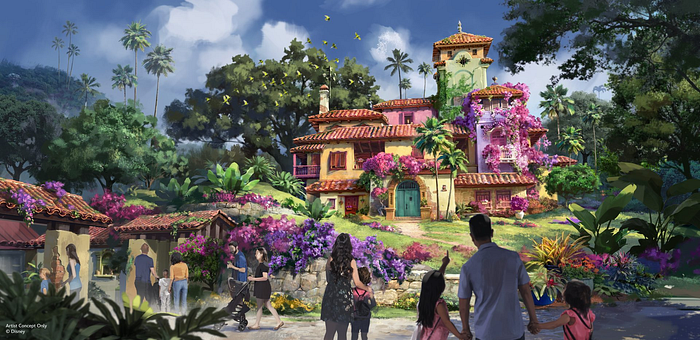
It’s too early to cast judgment on whether the attraction adheres to the park’s other themes, as we don’t yet know the specifics of the ride’s narrative. The concept art suggests that the ride building, though not necessarily succumbing to nature, is almost one with its surroundings, and given that the attraction will take guests through a rainforest, one could easily envision the value of nature being narratively communicated. That said, we don’t know if some sort of cognitively challenging idea or opportunity for psychological adventure will be presented, and the attraction, like Indy, looks set to follow a third person as opposed to placing parkgoers at the story’s center. There’s ample potential here for each of Animal Kingdom’s core motifs to be represented, but uncalculated design could leave the attraction thematically incohesive with the rest of the park; we won’t specifically know just how meticulous Imagineering was in the narrative’s crafting until we receive further information.
The carousel near the land’s entryway perhaps leaves the most to be desired thematically, though it’s perhaps unfair to expect an attraction as innocent as a merry-go-round to be some sort of psychologically stimulating experience. It looks as though the carousel aesthetically matches the architecture of the larger Pueblo Esperanza area and adds to its general feeling, but the ride featuring seats modeled after various Disney intellectual properties feels out of place; in a land intended to be an enveloping representation of a Latin American village, the idea of a local woodcarver loving Disney IPs so deeply to the point of constructing a working carousel celebrating them (as the ride’s story purports) perhaps impedes on immersion.
That said, it’s important to note that Animal Kingdom has long lacked a carousel; Rohde, in 2003, noted that the park “very clearly establish[ing] itself as a theme park in people’s minds” is crucial to its “survival,” and the addition of a carousel gives families another opportunity to experience an attraction historically associated with Disney Parks. It also bears mentioning that a large working carousel was proposed as a potential Animal Kingdom icon during its early stages of development; though the carousel it will ultimately receive is perhaps a bit cynical, it’s not going to singlehandedly destroy the park’s underlying motifs.
We’re still several years out from the completion of the Tropical Americas section of Animal Kingdom, and changes can (and likely will) be made to the land’s architecture and attractions before it ultimately opens in 2027; that said, it looks as though Imagineering, despite widespread concerns, is not only well aware of the park’s core themes, but made a concerted effort to adhere to them when crafting this concept. Not every single one of the park’s motifs will be exhaustively explored by each new offering, but no land or attraction currently at the park flawlessly checks every thematic box.
Initial word of the Tropical Americas overhaul of DinoLand U.S.A. prompted worry that Disney was attempting to shamelessly inject some recognizable brands into an area of the park that had become a corporate afterthought, and while this may have been the company’s initial motivation, it looks as though the park’s overarching narrative and subtextual themes weighed heavy on Imagineering’s mind as it developed the land. We won’t know if Tropical Americas is a worthwhile addition to Disney’s Animal Kingdom until several years from now, but there’s genuine reason for optimism.
Be sure to continue to follow Boardwalk Times for more coverage of The Walt Disney Company.
Support Boardwalk Times on Ko-Fi.
Support Boardwalk Times by shopping on Boardwalk Store:
If you like this article. Subscribe to my free newsletter Boardwalk Times: Stories from the Seashore, a monthly dose of Disney, its businesses, and the wider themed entertainment industry.
Kyle Silagyi is a columnist for the Boardwalk Times