
Since its groundbreaking entry into animated space, Pixar has shouldered a set of paradoxical expectations that outlined the antithesis of its success. The company saw immediate success in classics like Toy Story and Finding Nemo, but the audience interpretation appears to be contradictory to the brilliance of Pixar. Where creators had focused on strengthening the foundation of basic narratives, viewers saw the contrast in quality compared to the products of Disney and DreamWorks as some sign of auteurship. Not only were these films enjoyable, but many believed them to be revolutionary and experimental.
This appears to be a consistent issue in the way audiences view animation; not as a cinematic medium but a distinct genre, often underestimated until critical consensus notes otherwise. Audiences adore My Neighbor Totoro and Into the Spider-Verse for supposed narrative experimentation, and yet a seasoned viewer will recognize that the stories being told here are no different than those explored in live-action. This is not to say that these movies are bad, moreso that audiences appear to expect very little from animation, almost as if it is inherently fighting against a relationship to underdeveloped children’s media. Simply being stylistically brilliant is rarely good enough for most audiences to care.
Perhaps this is why so many viewers found themselves displeased by Pixar’s latest outing Luca, which left some viewers yearning for the “olden days”. Were the older films better, or do we experience more media as we grow in age, with the eventual realization that Pixar did little more than bring strong screenwriting to the medium of animation? Was Up a groundbreaking romantic tragedy, or were we too young to have seen any of its cinematic influences? The expectation of innovation would require Pixar to exist in a world exempt from its own influences, as the medium of animation did not receive any supplement besides increased legitimacy as a result of the production company’s support. The films aren’t getting worse, rather, audiences have begun to see animation as something greater than Saturday-morning advertisements.
It is in this way that Luca does what Pixar does best: introduce young audiences to dynamic, emotional, and sometimes subversive media through the guise of an unassuming medium. Luca is one of the best films released from the production house in a long time, and audiences should be deeply excited for an era of creative freedom from a group of animation’s greatest minds.
The past few years of cinematic torture that were the “Pixar Sequels” need not be discussed any further aside from a small lesson learned: films cannot be carried by name-branding alone. Every one of these test-audience-written and board-room-edited dumpster fires may have left audiences nervous for the future of Pixar animation, but the more optimistic viewers held onto the successes that were Coco and Soul as a hopeful spark in the increasingly dim cavern. Ignoring the subjective quality of the films, it appeared that Pixar was adhering to a path of realism in the stylings of their animation. Finding Dory, Incredibles 2, Toy Story 4, and even a majority of Soul chose to abandon the unlimited potential of abstract animation in favor of something more impressive to general audiences. Just as in other computer-generated mediums, realism is an easy way to garner attention for your animated product, sacrificing a distinct style in return for what may as well be the cinematic equivalent of a parlor trick: momentarily interesting.
In recent years, other studios have begun to explore more captivating and unique artistic directions for their animated films, appearing more timeless than any pursuit of realism ever would. The Peanuts Movie, The Lego Movie, Into the Spider-Verse, Wolfwalkers, Captain Underpants, and many others are just a few films developing styles wholly distinct from the traditional appearance of 3D animated films. In fact, many turn to the unrealistic and fantastical nature of 2D animation to better capture emotion in comparison to strict realism. Luca appears to be one of the first times Pixar has broken its tried-and-true character molds; a well-needed risk that clearly paid off in the end.
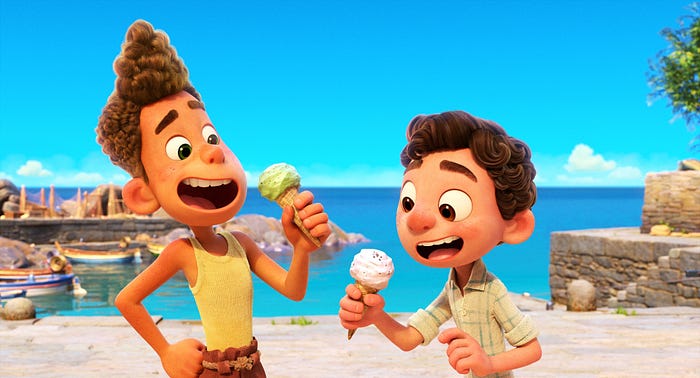
The film rarely sees graphically impressive visuals, rather, it uses unique animation and design to explore intricate characterization and world-building without undermining the script. Nothing captures the realism of Soul, but the visuals resonate more than anything that film had to offer. The more realistic settings (like Portorosso) are vibrant and colorful interpretations of real-world locations, whereas the more fantastical scenes underwater and imaginative dream sequences lift the restrictive boundaries of contemporary filmmaking to explore something more analogous to picture books of old. You’ll be surprised not only at how beautiful the animation is, but also at how much you find yourself lost in a world focused more on pleasing the eyes instead of the mind.
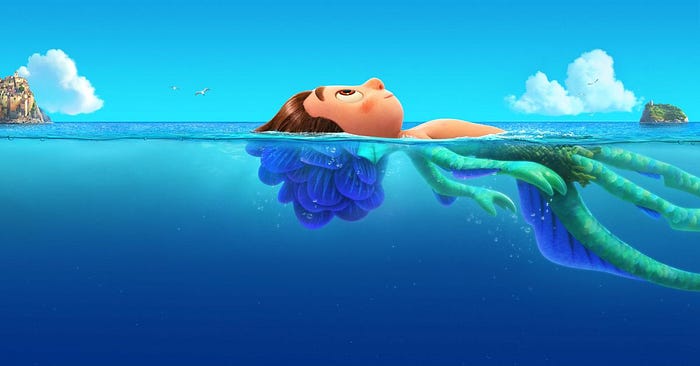
Centering on the titular sea-monster/human hybrid Luca Paguro’s desire to explore the surface, the film momentarily feels analogous to Disney’s classic The Little Mermaid. However, the aforementioned discussion of Pixar’s excellence finds a more concrete example when analyzing Luca. The characters may be from a fantastical world, and the plot feels simple from the outside, but the genius arises in the subtle (though sometimes overt) metaphors lying beneath the text. Toy Story may appear to be a film about lost toys, but a more complex analysis reveals the lingering ideas of aging, purpose, and family. Similar things can be said about most other Pixar films, indicating what appears to be a central thesis amongst the company’s creative team.
I do not love reviews that quote other reviewers, as the piece is supposed to reflect the mind and interpretation of the sole writer, but I find myself needing to reference the source of this next diatribe as it has been stuck in my brain ever since the connection was pointed out. In his review for IndieWire, David Ehrlich notes this, which we’ll come back to:
It’s no coincidence, then, that “Luca” is also the closest that Pixar has ever come to capturing the ineffable spirit of a Studio Ghibli film (and not just because Casarosa’s semi-autobiographical tale is set in the seaside Italian town of “Portorosso”)…
The film explores Luca’s desire to win a Vespa, a dream onset by a budding “friendship” (we’ll get to that) with fellow sea-monster hybrid Alberto Scorfano. Both of them yearn for a life of independence, with Luca directly disobeying his parent’s orders as he flees home for the local port. There’s a world outside of his visually indistinct ocean neighborhood, and only in exploring it will he find happiness in himself. Upon reaching town Luca and Alberto meet Ercole (the town bully who prides himself on his racing success) and Giulia (daughter of a local fisherman and racing underdog) as they learn that a Vespa is attainable by entering the town’s annual race. To achieve their dreams of exploring the world together, Luca and Alberto must train for the race and explore the town, all while hiding their secret identities and their presence from Luca’s parents, who have come to town in search of their son.
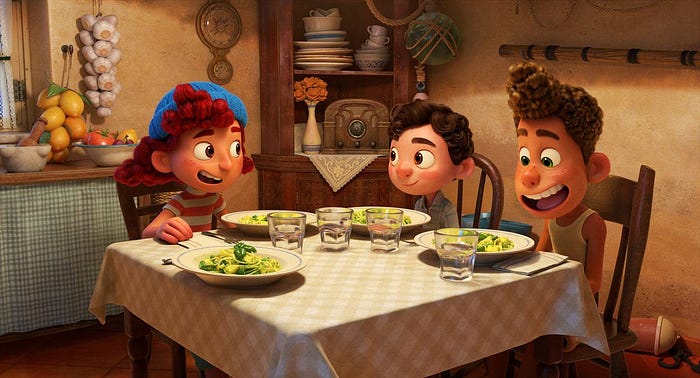
Moreso than any other Pixar film, Luca’s simple storyline remains as such in service of an intricate and complex metaphor. Ehrlich planted the idea deep within my mind of a relationship with Ghibli (echoed by Luca’s director Enrico Casarosa). Audiences familiar with Ghibli’s My Neighbor Totoro may understand what I mean, as that film follows a fantastical plot in service of an emotional and deeply personal narrative centered around the loss of someone close. Though the film shares deeper similarities to Ghibli (beautiful soundtrack, vibrant visuals, strong character writing, etc.), the most impactful is the dedication to narrative simplicity without sacrificing emotional weight. I may have been able to summarize the premise in just a few sentences, but to say that I’ve covered even a percent of the film’s complexity would be an insult to the brilliance on display.
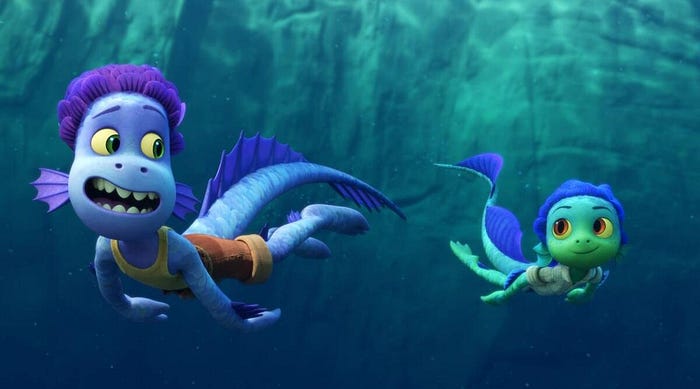
Perhaps I should address a rather important question about the film, that being “is this the first Disney film to feature a gay main character?” I don’t think this question has a particularly good answer, though my own interpretation of the film should give spoiler-free but meaningful commentary on this issue.
First, it should be noted that this film is partially autobiographical. Enrico Casarosa has stated that the film’s core premise reflects his friendship with Alberto Suarce, somebody the director met as a child in Genoa, Italy. In this interpretation, Luca is a story about the friendships that help us grow to who we are today and the acceptance that even the most powerful relationships are not meant to follow us into the next stage of our lives. The emotional paradox of the situation, where the friends that change our lives the most find themselves absent in that next chapter, is as heartbreaking as it is realistic.
The intimacy of Luca and Alfredo’s relationship, as well as the setting, drew parallels to Luca Guadagnino’s 2017 film Call Me By Your Name, which followed the budding relationship between two men in Lombardy, Italy, and the heartbreak that ensues in its aftermath. From these comparisons Casarosa took only the most positive of compliments, saying that he too loves Guadagnino’s films, but that there’s only a platonic relationship between his animated film’s leads. Of course, I must respect the author’s intentions when interpreting his work, but I can’t help but feel my emotional reaction to the film is far more important than whatever the author intended. How is it that, in a film about platonic relationships, many found themselves not only heartbroken but validated?
Perhaps this is a result of a cultural translation, where Italian friendship may be more intimate than those in the United States, or at the very least, the art romanticizes personal relationships more than anything we see here. The film may not have intentionally queer subtext, but I would anticipate most audiences feeling some sort of relationship between the two leads that extends into something more personal than the traditional friendship. Though it’s certainly time for Disney to feature representation far more explicit than anything in their current backlog, Luca explores the concept with a light, respectful touch. Frankly, I don’t know how one would interpret the film’s final scene without an analysis of queer-coded subtext, something that only benefitted the finale’s emotional climax.
In the mind of this reviewer, Luca is a film about coming to terms with one’s sexuality, individuality, and the fleeting nature of unfeigned romance. Choosing to ignore this subtext is possible, though it removes a quality that significantly improved my experience and would likely change my enjoyment dramatically.
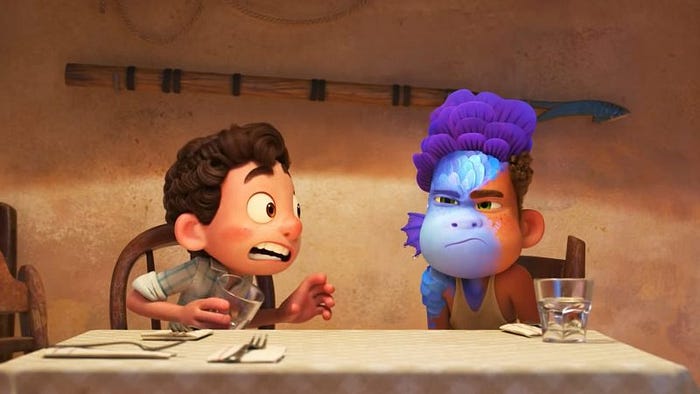
Pixar films are notorious for their ability to elicit tears from the audience, but recent films have shown that even Pixar themselves are clueless as to the reasons why we cry. Character death is certainly a sad way to end a film, but this rarely draws the emotions that one expects to feel from a Pixar film. Audiences are deeply mistaken as to the root cause of their sadness following Toy Story 3 or Inside Out, attributing it to a tragic narrative or a particularly depressing moment. You may have thought that the furnace scene made you cry, but are you sure it wasn’t the moment Andy had to grow up? Was it the death of Bing-Bong that started the waterfalls, or was it the development of Riley’s first bittersweet memory? The cultural significance of cheap tear-jerkers limited the audience’s appreciation for finely crafted emotional moments, and Pixar has since tried to live up to the depressive expectation set by misinterpretation.
Luca fulfills the “kleenex-quota” that audiences expect with Pixar, but in such a way that doesn’t feel unearned. There’s sadness in the conclusion, especially for viewers like myself who found the underlying narrative subtext meaningful, but it is earned by the film’s brilliant character development. The tears pour out not because of a forced emotional moment, but from a character-building crescendo. Everything falls into place at the right time, and what happens… happens. The moments are fleeting, but love and passion are eternal.
If I could include one complaint, it would be that Disney foolishly prevented audiences from experiencing this film in theaters. Luca is certainly less cinematic than other films which may have justified the decision to deliver a more personalized experience with at-home streaming, but I do wish I could’ve seen the film in IMAX as originally intended (according to the credits). The colors pop just fine on a 4K television set, but the subdued yet intricate music would have fared far better on a theatrical setup.
Luca may not have the best screenwriting in Pixar history, nor does it break as many technical boundaries as other more realistic films, but the emotional charm and genuine joy elicited by the simple plot and colorful designs offer a tight, enjoyable experience rivaling the greatest animated films of all time. The film is genuine in the purest way, questioning very little as it gives audiences a stylized way to appreciate what life has to offer. Those who give the film’s honest simplicity a chance are certain to be delighted, even if it comes at the price of a few misplaced tears.
Score: 10/10
Ryan Dorman is a Columnist and the Content Director for the Boardwalk Times. He can be found on Twitter at @OpentheDorman.